Security Verification and Offensive-Defensive Practice
Why outstanding security teams are adopting Purple Teaming

A Purple Team strategy combines the offensive tactics of the Red Team with the defensive measures of the Blue Team to form a unified cybersecurity approach. Communication and collaboration are the foundations of this strategy, with a focus on continuously identifying and narrowing security gaps and shortfalls to ensure the cybersecurity defense system is robust enough and capable of responding to evolving threats.
Below, we will delve into the inner workings of the Purple Team and its indispensable role in strengthening cybersecurity defenses, as well as how to strategically implement this approach to stay one step ahead of attackers.
▌What is a Purple Team?
The Purple Team is a strategic mindset in the cybersecurity field that combines the skills of Red Team and Blue Team professionals to find and fix any potential attack paths that could allow attackers to compromise an organization's IT infrastructure.
This combined strategy strengthens an organization's security posture through a continuous loop of feedback, knowledge transfer, and complex cyberattack simulations. The Purple Team strategy aims to discover any potential attack paths and propose actionable detection and mitigation recommendations.
Generally speaking, a Purple Team can be a dedicated independent team, such as in the security departments of large enterprises. An ideal comprehensive Purple Team usually contains people we typically refer to as Red Team and Blue Team personnel, including penetration testers, security analysts, incident responders, threat intelligence personnel, and data security managers.
But we can also say that Purple Teaming is a strategy that leverages the strengths of both Red and Blue Teams. Whether an independent team is established or not, the purpose of a Purple Team is to help the organization continuously identify and address security gaps, thereby creating stronger and more effective defenses against real-world cyber threats.
▌What is the purpose of a Purple Team in cybersecurity?
The purpose of the Purple Team is to leverage the combined expertise of the Red Team and Blue Team to strengthen the organization's security posture, enhance detection and response capabilities, and proactively identify and mitigate risks.
1. Enhance Detection and Response Capabilities
By conducting joint offensive and defensive drills and attack simulations, the Purple Team helps the Blue Team improve its ability to detect and respond to real-world cyber threats. The Red Team provides realistic attack scenarios, enabling the Blue Team to identify and address any weaknesses or gaps in its detection and response processes.
2. Assess Security Measures
The Purple Team can assess the effectiveness of an organization's existing security products and measures, such as Next-Generation Firewalls (NGFW), Intrusion Detection and Prevention Systems (IDS/IPS), and endpoint protection solutions such as Endpoint Detection and Response (EDR), Extended Detection and Response (XDR), and Security Information and Event Management (SIEM).
Through collaboration, the Red Team simulating the attack can attempt to bypass these defenses, while the Blue Team, focusing on defense, can monitor and analyze their activities. This collaboration helps identify potential defensive weaknesses and other areas where security defenses need to be strengthened.
3. Identify and Prioritize Vulnerabilities
Purple Team exercises can uncover an organization's vulnerabilities and potential attack paths that adversaries could exploit to achieve their objectives. The Red Team identifies weaknesses and exploits them, while the Blue Team assesses the impact and severity of the vulnerabilities and develops actionable remediation strategies. This collaborative approach helps prioritize remediation efforts based on the real-world risks faced by the organization.
4. Strengthen Communication and Collaboration
The Purple Team promotes better communication and collaboration between the Red Team and the Blue Team. By working together, these teams can share knowledge, techniques, and best practices. This collaboration helps bridge the gap between offensive and defensive perspectives, leading to a more comprehensive understanding of the organization's security posture.
5. Continuous Capability Improvement
The Purple Team approach promotes a virtuous cycle of continuous optimization and improvement. Through regular collaboration and joint exercises, organizations can refine their security measures, incident response processes, robust operations platform correlation analysis rules, and overall cybersecurity strategy. Lessons learned from Purple Team exercises can be used to update policies, implement new technologies, and train personnel effectively.
Overall, the purpose of the Purple Team is to improve an organization's cybersecurity defense capabilities by facilitating collaboration and knowledge sharing between the Red Team and the Blue Team.
▌What are the benefits of Purple Team exercises for an organization?
By conducting continuous Purple Team exercises, organizations can significantly enhance their security posture. By combining the expertise of offensive and defensive teams, threat response is enhanced, knowledge sharing is promoted, and the most effective use of security resources is ensured.
1. Comprehensive Approach to Cyber Threat Management
Purple Teaming is an integrated threat management approach. By combining the Red Team's offensive tactics and the Blue Team's defensive strategies, Purple Team exercises can:
Identify attack paths adversaries might take to compromise the organization's systems and networks
Collaboratively develop mitigation solutions, resulting in a stronger cybersecurity strategy

Build, Attack, and Defend Triangle Model (Daniel Miessler)
2. Improve Incident Response
Through Red and Blue Team collaboration, Purple Teaming improves incident response. They can simulate attacks, assess the organization's response, and then fine-tune that response based on actual results. This not only shortens the Mean Time to Detect (MTTD) and Mean Time to Respond (MTTR) to threats, but also provides more effective mitigation recommendations.
3. Knowledge Sharing and Transfer
The Purple Team fosters a learning environment where knowledge of offensive and defensive strategies can be freely shared. This continuous exchange leads to ongoing improvements, thereby increasing the overall cybersecurity maturity of the organization.
4. Reduce Alignment Gaps Between Red and Blue Teams
The Purple Team acts as a bridge between the Red Team and the Blue Team, facilitating communication and collaboration. This alignment eliminates any potential information silos, ensuring all teams are committed to the common goal of protecting the organization's security.
5. Increase ROI
Through coordinated efforts, the Purple Team can help organizations maximize the return on investment in cybersecurity tools and personnel. By identifying blind spots and strengthening defenses, they ensure resources are utilized effectively.
6. Adapt to Evolving Threats
Cyber threats are constantly evolving, and static defenses are far from enough. Purple Team exercises provide a proactive defense mechanism to continuously test, learn, and adapt to new Tactics, Techniques, and Procedures (TTPs) in the threat landscape.
▌Red Team, Blue Team, and Purple Team
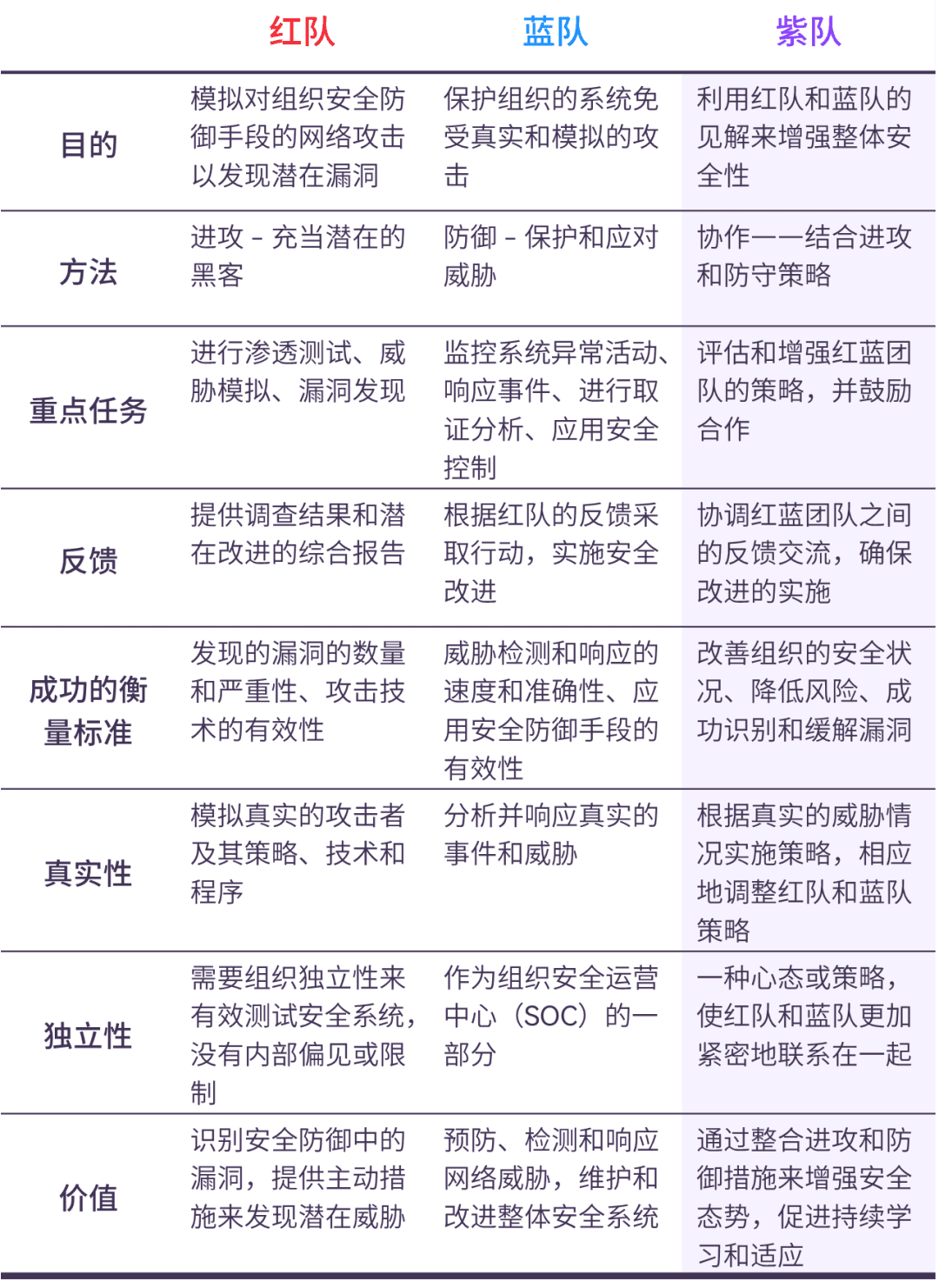
Purple Teaming is a mindset that requires cooperation between the Red Team and the Blue Team, combining defensive and offensive expertise from both sides to develop more effective security strategies. This combination enables organizations to identify and respond to threats with a speed and efficiency that exceeds what either the Red Team or the Blue Team could achieve alone.
Below is a comparison of the roles and responsibilities of the Red, Blue, and Purple Teams in cybersecurity:
▌Purple Team Operational Mechanism
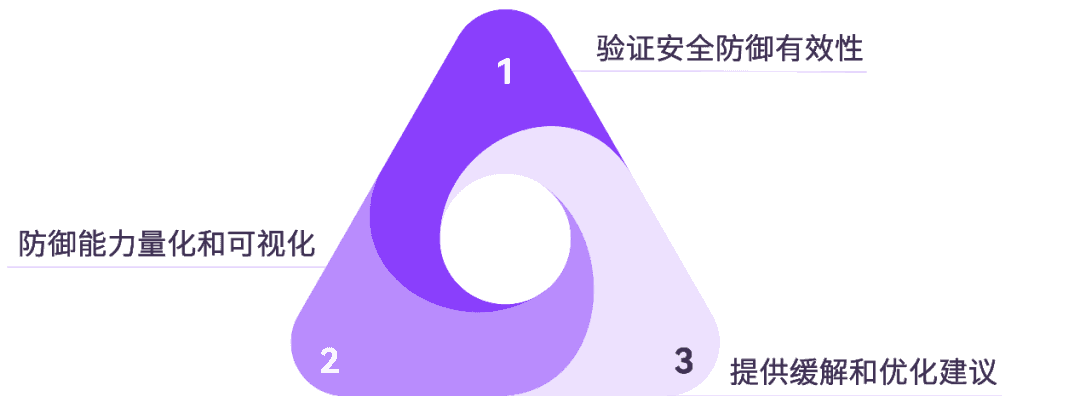
The Purple Team assessment and mitigation cycle is an iterative process designed to continuously improve and optimize an organization's overall cybersecurity. This cycle involves the integration and collaboration of the Red Team and Blue Team to ensure robust and comprehensive security measures.
Purple Team Operational Cycle
1. Validate the Effectiveness of Your Security Defenses
The operation of the Purple Team begins with the Red Team's attack behaviors, simulating and executing various attack techniques to expose potential attack paths that could be exploited to compromise the organization's systems and networks, thereby discovering weaknesses in the organization's defenses and evaluating the effectiveness of existing security measures.
2. Quantification and Visualization of Defense Capabilities
After the attack behaviors expose the organization's security defense shortfalls, they will be presented to personnel at all levels in a quantified and visualized manner. At this point, the Purple Team needs to implement the Blue Team's corresponding actions, assessing which issues require immediate attention and prioritizing them.
3. Provide Mitigation and Optimization Recommendations
The Purple Team strategy is to effectively pass the Red Team's attack paths and used techniques and tactics—information from an attacker's perspective—to the Blue Team's role, which means proposing targeted mitigation and response recommendations. The key point of this process lies in the high level of information sharing between the Red and Blue Teams.
Once Blue Team actions such as risk assessments and mitigation processes are completed, the organization can re-run the Red Team attack behaviors to validate the updated defenses.
The continuous loop of validation and mitigation enables the Red Team and Blue Team to stay ahead in the constantly changing threat landscape. The Purple Team strategy helps organizations build and maintain optimal defenses by promoting this cycle.
▌What are the challenges of Purple Teaming?
Purple Team challenges include managing limited time and resources, prioritizing different adversary tactics and security vulnerabilities, and tailoring mitigation and detection strategies to fit specific security measures.
1. Limited Time and Resources
The process of the Red Team simulating thousands of adversary Tactics, Techniques, and Procedures (TTPs) is both time-consuming and resource-intensive. Furthermore, the rapidly changing cyber threat landscape requires rapid response from Threat Intelligence (TI), Red, and Blue teams. These constraints make it difficult for organizations to manage processes based on continuous improvement and maintain a high level of coordination among Red, Blue, and IT teams.
2. Prioritizing Shortfalls and Adversary TTPs
For the security teams of most organizations, achieving comprehensive coverage of adversary TTPs or MITRE ATT&CK techniques over a long period is highly challenging. Therefore, Red and Blue Teams need to prioritize TTPs and weaknesses in defense strategies, making the tasks of preventing and detecting these TTPs more precise.
3. Developing Actionable Mitigation and Detection Strategies
While there are many resources online that provide general mitigation and detection recommendations, these recommendations often cannot be directly implemented. This requires teams to adapt and customize these strategies, which adds extra complexity.
▌How Security Validation Achieves Purple Team Value
Security validation explores the intersection of advanced cybersecurity practices and automated testing. By restoring real APT attack scenarios and continuously validating various security defense products and measures, it maximizes the Purple Team's role in helping organizations remain resilient and adapt to the changing threat environment.
1. Threat Intelligence
The security lab has been tracking new attack methods used by various threat groups and ransomware gangs. Through the security metrics validation platform, we provide our users with multi-dimensional, verifiable threat intelligence based on attack techniques. Users analyze this threat intelligence to identify relevant threats in their industry and location.
In addition, the platform provides actionable mitigation recommendations for tracked new threats, enabling teams to respond quickly.
2. Validation Scope Covers Various Security Measures
Security validation restores real attack scenarios and methods. These methods target the overall defense system and measures, and therefore can cover a wide variety of security products and solutions, including but not limited to:
Next-Generation Firewall (NGFW)
Web Application Firewall (WAF)
Network Traffic Analysis (NTA)
Intrusion Detection and Prevention Systems (IPS and IDS)
Endpoint Detection and Response (EDR) solutions
Email Gateway solutions
Antivirus and Anti-malware solutions
Extended Detection and Response (XDR) technology
Containerized Security solutions
Data Loss Prevention (DLP) solutions
Runtime Application Self-Protection (RASP)
Security Information and Event Management (SIEM) systems
Security validation offers a variety of scenarios while providing clients with the flexibility to customize scenarios, ensuring comprehensive security validation.

Implementing Purple Team Strategy Through Security Validation
As a Purple Team strategy, security validation can run continuously and periodically based on organizational needs, helping the organization maintain adaptability and resilience, thereby keeping the organization's security posture in sync with the evolving threat landscape.
3. Discovering Defense Shortfalls Through Security Validation
Through continuous periodic and comparative validation, it facilitates gap analysis of security defense measures. By aggregating monthly, quarterly, or annual validation results, organizations can identify and report actually validated defense shortfalls, thereby gaining a clear understanding of the organization's security posture.
4. Issue Discovery and Mitigation Optimization Enabled by Security Validation
Security validation can significantly improve deficiencies in an organization's preventive and detective security defense measures:
1)Fixing Omissions in Security Operations and Maintenance
During the security validation process, the security metrics validation platform assists users in discovering various issues that are difficult to surface during daily security operations. These issues include:
Whether various security devices are working properly—load conditions, signature database updates, log dispatch locations, and time accuracy;
Whether critical assets are properly protected—coverage of endpoint solutions, working status of endpoint solutions, and host behavior auditing status;
Whether Security Information and Event Management (SIEM) or Security Operations Center (SOC) are receiving logs normally—log time accuracy, log storage location, log processing delay, and log loss.
Issues like those mentioned above are hard to detect yet occur frequently. After discovering these issues through validation, the security validation platform helps users resolve their security blind spots, which helps improve the detection and alerting capabilities during the user's security operations to confirm there are no broken points in the entire closed-loop process.
2)Improving Deficiencies in Preventive Security Measures
Currently, the vast majority of security products work based on signature databases. Security validation can help detect gaps in these products' signature databases, including the continuous update status and completeness of the signature databases. The security metrics validation platform can provide signature hash values for all validation samples, enabling operations teams to customize detection rules based on the unique requirements of the organization and the security products they use.
3)Mitigating Alert Fatigue and Improving Alert Accuracy
Currently, massive amounts of alerts exist in users' SIEM, SOC, or XDR platforms. Security operations teams immerse their daily work in processing an infinite loop of massive alerts, which ultimately causes alert fatigue for the operations team. How to extract more accurate, effective, and actionable alerts from this massive volume of logs has become a headache for operations teams. Through its unique attack intelligence on threat groups and ransomware gangs, the security metrics validation platform forms directly verifiable attack playbooks. These playbooks are arranged based on attack stages and will trigger alerts on various security products during the validation process. Users can create alert use cases on their operations platforms targeting these threat groups or attack techniques based on these security alerts to improve the platform's alert accuracy.
4)Remediation Through Mitigation Recommendations
Finally, the security metrics validation platform provides attack techniques and specific, actionable mitigation recommendations for all threats in the threat library. These attack techniques and mitigation recommendations support the Blue Team in implementing comprehensive remediation measures. It includes rules specific to certain security products as well as vendor-agnostic rules, and every rule is regularly tested for false positives. The security metrics validation platform further enhances this capability by providing specific SIEM and EDR detection rules, as well as vendor-agnostic SIGMA rules.
Overall, security validation automates many aspects of the Purple Team process, making it more efficient, consistent, and comprehensive. This continuous, automated approach can help organizations improve their security posture, identify and close security gaps faster, and respond more effectively to real-world threats.
▌FAQ Q & A
How often should an organization conduct Purple Team exercises?
Organizations should consider conducting Purple Team exercises continuously to maintain an up-to-date security posture and respond effectively to evolving threats. Security validation can continuously assess the effectiveness of security measures, identify security gaps, and provide actionable mitigation recommendations based on executed attack techniques, thereby achieving a proactive and adaptive cybersecurity approach.
How does Purple Teaming improve the detection of undetected successful adversary activity?
The Purple Team strategy promotes collaboration between the Red Team and the Blue Team, allowing for comprehensive security analysis to ensure that even undetected successful adversary activity can be detected. This collaborative approach bridges communication gaps, thereby improving the understanding and detection of security threats.
What skills are required for a Purple Team?
Essential skills for a Purple Team include a deep understanding of both offensive and defensive cybersecurity strategies. This includes penetration testing, intrusion detection, vulnerability assessment, threat intelligence, incident response, and security analysis. Strong communication skills are also required to ensure effective collaboration between the Red and Blue Teams.
Can smaller organizations benefit from implementing a Purple Team strategy?
Even smaller organizations can benefit significantly from Purple Teaming. It can help them understand their security posture, identify weaknesses, and design effective mitigation strategies. Additionally, it enables these organizations to keep their defense strategies up to date against the evolving cyber threat landscape.
How does a Purple Team contribute to an organization's overall security posture?
The Purple Team enhances an organization's overall security posture by combining the strengths of both the Red Team and the Blue Team. It ensures a comprehensive assessment of security defenses, identifies weaknesses, and provides actionable mitigation strategies. By promoting collaboration, it enables the organization's defenses to adapt and respond to real-world threats.


