Security Verification and Offensive-Defensive Practice
Mirroring the MITRE Top 25 Most Dangerous Software Weaknesses: Implementing a Systematic Security Verification Strategy

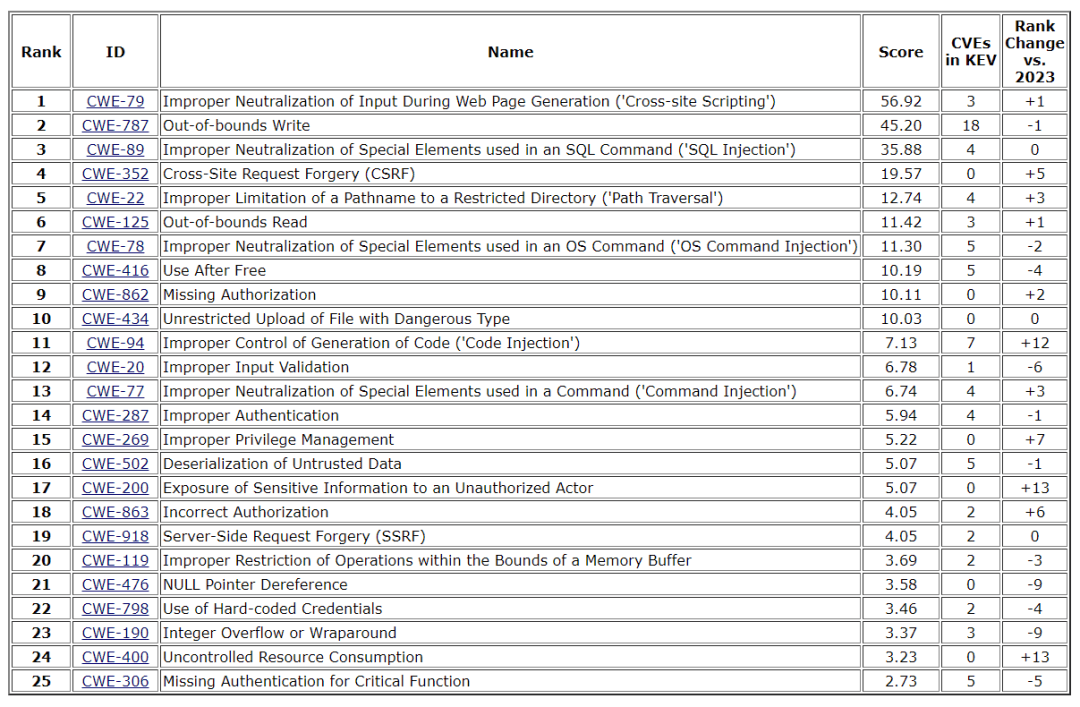
Against the backdrop of the global wave of digitalisation, software security remains a major challenge for enterprises. Recently, MITRE released its 2024 Top 25 Software Weaknesses report, outlining a panoramic view of current software vulnerabilities based on an analysis of over 31,000 CVE records between June 2023 and June 2024. By deeply interpreting this report, we can not only clearly see the current security landscape but also gain insights into future development trends.
▌Key Findings: Risks and Opportunities in Software Security
New and Old Challenges in Web Security
Cross-Site Scripting (XSS, CWE-79) has returned to the top of the chart with a high score of 56.92, a phenomenon that invites deep reflection. In today's rapid iteration of Web technologies, why is this vulnerability type, which has existed for years, still so prevalent? This is closely related to the characteristics of current enterprise digital transformation.
As enterprise business continues to migrate to the cloud, the scale and complexity of Web applications are rapidly increasing. A large number of user interaction scenarios provide a broader attack surface for XSS. Particularly in sectors such as e-commerce and finance, complex front-end interactions and dynamic content rendering make input validation and output encoding extremely difficult. Even experienced development teams may overlook security details when handling complex business logic.
More notably, with the rise of low-code platforms, the barrier to application development has been significantly lowered. While this change improves development efficiency, it also introduces new security risks. Many developers using low-code platforms may not understand the attack principles and defence methods of XSS, leading to unintentionally introducing security vulnerabilities during the development process. This situation is particularly common in the development of internal corporate systems.
Memory Safety: Hidden Systemic Risks
Out-of-bounds Write (CWE-787) ranks second with a high score of 45.20, which is by no means accidental. Under the background of the rapid development of China's Industrial Internet, the impact of memory safety issues is constantly expanding. Especially in the process of digital transformation in the manufacturing industry, a large number of legacy industrial control systems are connected to modern network environments, and memory vulnerabilities in these systems could lead to severe security incidents.
Taking a large manufacturing enterprise as an example, when upgrading their intelligent manufacturing systems, they found that the control programs of multiple critical equipment had buffer overflow risks. These programs had been running stably for years, but in the process of integrating with the new system, the originally hidden memory safety issues gradually surfaced. Once exploited, it could not only stop the production line but also lead to equipment damage and personal safety hazards.
In the financial sector, memory safety issues likewise cannot be ignored. A bank discovered during a routine security check that a third-party component in its core transaction system contained a memory vulnerability. Attackers could potentially trigger an out-of-bounds write through a carefully crafted request, thereby tampering with transaction data. The characteristics of such vulnerabilities are high concealment and severe harm, which once exploited, could cause significant financial losses.
Evolutionary Trends of Emerging Vulnerabilities
This year's ranking changes reflect a profound shift in software security threats. The ranking of Code Injection (CWE-94) rose by 12 places, which is closely related to the evolution of enterprise technology architectures. Under a microservices architecture, dynamic configuration and hot updates have become standard features, but these convenient functions also provide new attack vectors for code injection.
An internet company introduced dynamic script execution capabilities to support rapid business iteration while upgrading its microservices framework. However, due to incomplete verification mechanisms, attackers could inject malicious code by modifying configuration parameters. This risk is particularly pronounced in cloud-native environments, as frequent interactions between services increase the attack surface, while containerised deployments make the scope of a vulnerability's impact harder to control.
The sharp rise in the ranking of Information Disclosure (CWE-200) reflects another reality: with the implementation of the Data Security Law and the Personal Information Protection Law, data security has become an important issue that enterprises cannot ignore. Especially in the current context of data-driven innovation, how to fully leverage data value while ensuring security and compliance has become a thorny problem.
Zero-day Vulnerabilities: Shorter Response Windows
Data shows that among the vulnerabilities exploited in 2023, the proportion of zero-day vulnerabilities has exceeded 50%, a figure that serves as a wake-up call. The time window from vulnerability disclosure to exploitation is shrinking dramatically, presenting a severe challenge to enterprise security response capabilities.
Traditional patch management processes often require multiple stages such as testing, approval, and batched deployment, with cycles that can last weeks or even longer. However, in the current threat environment, enterprises may only have a few days or even a few hours to respond to newly discovered vulnerabilities. This requires enterprises to establish a faster and more agile vulnerability response mechanism.
At the same time, supply chain complexity further exacerbates this issue. A seemingly insignificant component vulnerability can affect the entire business system through dependencies. An e-commerce platform was once forced to urgently upgrade its system during a shopping festival due to a vulnerability in an open-source logging component, putting immense pressure on operations.
▌Redefining Security Validation Strategies
Facing these challenges, we need to optimize our security validation strategies in the following aspects:
Building a Multi-dimensional Validation Scheme
Traditional security validation is often limited to a single dimension, such as the network layer or application layer. However, current high-risk vulnerabilities often involve multiple levels. For example, a seemingly simple XSS vulnerability may require simultaneous validation of the effectiveness of multiple protective links such as front-end filtering, server-side verification, WAF, or RASP rules.
In the practice of a financial institution, we implemented parallel validation across different network zones and security devices by deploying distributed validation nodes. This approach not only improves validation efficiency but, more importantly, can detect cross-level security issues that single-point validation might overlook.
Continuous Validation Mechanism
Security is not a static state, but a process that requires continuous validation and confirmation. Especially in modern IT environments where system configurations, business logic, and protection strategies are constantly changing, any change can affect the effectiveness of existing security measures.
We recommend that enterprises establish a "high-frequency, small-scope" validation model, rather than traditional "low-frequency, large-scope" scanning. By breaking down validation tasks into multiple small, highly targeted checklist items, issues can be detected timely without putting too much pressure on production systems.
Scenario-based Validation Mindset
When designing validation schemes, it is necessary to fully consider the enterprise's actual business scenarios. For instance, for the Resource Exhaustion software weakness (CWE-400) in the Top 25, traditional validation methods may be difficult to test fully in a production environment. In this case, it is necessary to design schemes that can effectively validate protection measures without affecting business operations.
An e-commerce platform innovatively adopted a small-scale validation method based on actual traffic characteristics to meet such challenges. Through analysing production traffic, they built validation use cases that conform to actual scenarios, which ensured the effectiveness of the validation while avoiding impacts on business operations.
Dynamic Protection Capability Validation
Faced with new threats such as zero-day vulnerabilities, merely validating protection measures for known vulnerabilities is insufficient. Enterprises also need to validate the dynamic protection capabilities of their security architecture. This includes:
Validating the effectiveness of anomaly detection systems
Assessing the dynamic adjustment capability of security strategies
Testing the feasibility and effectiveness of emergency response mechanisms
For example, a government agency verified not only the effectiveness of specific protection measures but, more importantly, tested the collaborative response capability of the entire security system through regular red-blue team confrontation exercises.
Automation and Intelligence in Security Validation
As the complexity of enterprise IT environments continues to rise, manual validation can no longer meet demands. Automation and intelligence are becoming inevitable trends in the field of security validation. However, it should be noted that automation is not a simple piling up of tools, but rather building an intelligent validation platform that can achieve the following objectives:
Adapt to environmental changes and dynamically adjust validation strategies
Update validation content timely based on threat intelligence
Intelligently analyse validation results and provide feasible optimization recommendations
▌Best Practices: Security Validation Strategy Framework
We need to build a more systematic and continuous validation strategy. Based on extensive practical experience, we propose the following in-depth validation strategy framework.
Layered Validation: Building a Complete Validation Chain
When designing validation schemes, it is necessary to establish a complete layered validation system. Taking the most common XSS vulnerability (CWE-79) in the Top 25 as an example, a complete validation chain should include: Part.1
Front-end Protection Validation
Validate the actual protective effect of the Content Security Policy (CSP), rather than simply confirming its configuration
Test whether the XSS protection functions of JavaScript frameworks are correctly enabled on all pages
Validate the effectiveness of filtering rules for special components such as rich text editors
Part.2
Middle-layer Validation
Perform fine-grained validation of WAF's XSS protection rules, including:
Conventional cross-site scripting attack payloads
Bypass techniques under specific business scenarios
Handling capabilities for various encoding methods
Validate API gateway input validation rules
Check the security header configuration of load balancers
Part.3
Server-side Validation
Validate the processing logic of server-side filters
Check the escape function of template engines
Validate whether the log auditing mechanism can effectively record attack behaviours
This layered validation is not a simple vulnerability scanning, but aims to design specific validation use cases for each protection layer.
For example, when validating WAF's XSS protection capabilities, the following points need to be considered:
Special character combinations based on business scenarios
Handling of different encoding methods (URL encoding, Unicode encoding, etc.)
Detection capability of nested attack payloads
Processing logic for specific business parameters
Validation Implementation Methodology: Continuous, Scenario-based, and Correlated Validation
Part.1
Continuous Validation Mechanism
Continuous validation is not a simple periodic scan, but requires the construction of a refined validation system:
1. Validation Frequency Grading
Core Protection Capabilities: Multiple validations per day
WAF key rules effectiveness
Access control strategy execution status
Status of critical security components
Extended Protection Capabilities: Daily validation
Security configuration integrity
Patch deployment effectiveness
Log auditing function
Comprehensive Protection Capabilities: Weekly validation
Cross-system collaborative protection
Security strategy consistency
Coverage of newly added protection measures
2. Validation Depth Grading
Quick Validation: Validate basic protection functions
Routine Validation: Check the integrity of protection rules
In-depth Validation: Test complex attack scenarios
Comprehensive Validation: Assess overall protection effectiveness
3. Event-driven Validation
Effectiveness validation after configuration changes
Protection validation after new vulnerability disclosures
Hardening validation after security incidents
For example, when validating SQL Injection (CWE-89) protection, the following validation strategy can be adopted:
1. Quick Validation (Hourly)
Check if critical SQL injection protection rules are in effect
Validate whether pre-configured protection strategies are running normally
Confirm whether the monitoring and alarm mechanisms are normal
2. Routine Validation (Daily)
Validate the protective effect against various types of SQL injection attacks
Check special syntax handling for different database types
Validate the enforcement of parameterised queries
3. In-depth Validation (Weekly)
Test complex SQL injection bypass techniques
Validate injection protection for stored procedures
Check the protection capability against second-order injections
Part.2
Scenario-based Validation Strategy
Scenario-based validation needs to stand from the perspective of an attacker and design validation schemes based on a complete attack chain. We have designed the following defense-in-depth validation system based on the attack chain:
Layer 1: External Network Penetration Defense Line Validation
Validation Goal: Validate the effectiveness of boundary protection
Key Focus: Actual protective effects of security devices such as NGFW, WAF, and IPS
Protection Level | Validation Scenario | Validation Focus |
|---|---|---|
Web Application Protection | TOP 25 software weaknesses protection validation Business logic vulnerability validation | WAF rules effectiveness Business parameter validation |
Traffic Monitoring Protection | Abnormal traffic identification Attack behavior identification | IPS rules effectiveness Traffic baseline conformity |
Access Control Protection | Identity authentication effectiveness Access control effectiveness | Authentication mechanism effectiveness Authorization strategy enforcement |
Layer 2: Lateral Movement Defense Line Validation
Validation Goal: Validate the effectiveness of internal network security protection measures
Key Focus: Actual effects of measures such as network isolation and permission control
Protection Level | Validation Scenario | Validation Focus |
|---|---|---|
Network Isolation | Inter-zone access control Core zone protection measures | ACL rules effectiveness Isolation measures integrity |
Permission Management | Privileged operation control Privilege escalation protection | Permission strategy enforcement Abnormal behavior identification |
Traffic Control | Abnormal connection detection Lateral movement identification | Traffic monitoring effectiveness Abnormal behavior warning |
Layer 3: In-depth Breakthrough Defense Line Validation
Validation Goal: Validate the effectiveness of core asset protection
Key Focus: Actual effects of measures such as data security and behavior monitoring
Protection Level | Validation Scenario | Validation Focus |
|---|---|---|
Data Protection | Sensitive data access control Data transmission encryption | Access control effectiveness Encryption measures effectiveness |
Behavior Monitoring | Abnormal behavior identification High-risk operation monitoring | Monitoring rules effectiveness Alarm mechanism effectiveness |
Audit Traceability | Operation behavior recording Security incident traceability | Log integrity Audit capability effectiveness |
Part.3
Composite Scenario Correlation Validation
Validation of a single vulnerability can no longer satisfy current security requirements. We need to design correlation validation for composite scenarios:
1. Vulnerability Chain Validation
Considering multiple vulnerabilities that might simultaneously exist in a business system, when designing validation schemes, it is necessary to:
Identify possible combinations of vulnerabilities
Validate the correlation between vulnerabilities
Assess the possibility of combined exploitation
2. Protection Chain Validation
Validate the collaborative protective effect of multiple security components:
Check the coordination between protective measures
Validate the consistency of security strategies
Assess overall protective effects
3. Emergency Response Validation
Combine vulnerability validation with emergency response:
Validate vulnerability detection capabilities
Assess the effectiveness of response measures
Verify the effectiveness of remediation schemes
Part.4
Validation Effectiveness Measurement
Key Validation Metric System
1. Coverage Metrics
Asset Coverage = Identified Assets / Actual Total Assets
Protection Coverage = Protected Points / Points That Should Be Protected
Validation Coverage = Validated Items / Items That Should Be Validated
2. Effectiveness Metrics
Protection Effectiveness Rate = Successful Protections / Total Attacks
Detection Accuracy Rate = Accurate Alarms / Total Alarms
Response Timeliness Rate = Timely Disposals / Total Alarms
3. Compliance Metrics
Configuration Compliance Rate = Compliant Configurations / Total Configurations
Strategy Execution Rate = Executed Strategies / Total Strategies
Baseline Conformity Rate = Meeting-standard Items / Total Baseline Items
Continuous Improvement Mechanism: Data Comparison
Comparison with historical baseline data
Comparison with industry best practices
Comparison with compliance requirements
The specific implementation of the validation system should be adjusted according to the enterprise's actual situation, focusing on core scenarios that have a significant impact on the business. Through this in-depth, systematic validation strategy, enterprises can truly establish an effective security protection system and ensure its continuous and effective operation.
With the popularization of cloud-native technology and the widespread application of artificial intelligence, software security will face new challenges. The adoption of technologies such as container orchestration and service mesh has made application architectures more complex, and traditional security boundaries are gradually disappearing. Meanwhile, the popularization of artificial intelligence applications has introduced new security threats such as model security and data poisoning.
Under these circumstances, enterprises need to view security construction with a more open mindset. Security is no longer the responsibility of a single department or stage, but a systemic project that needs to run through the entire software lifecycle. Only by establishing a continuous and comprehensive security validation mechanism can enterprises embrace innovation while ensuring security during their digital transformation process.


