AI Security and Intelligent Operations
Under the new Cybersecurity Law regulations, how can AI verification make security protection "visible"?

Today, as the wave of digitalization sweeps through all industries, cybersecurity has become the cornerstone of enterprise survival and development. With the recent passage of amendments to the Cybersecurity Law, a clear signal has been released:
Traditional security defense approaches are no longer sufficient to cope with increasingly complex cyber threats. The state explicitly supports the use of new technologies such as artificial intelligence to improve cybersecurity protection levels. Effectiveness validation, a new subject in cybersecurity In the security operations centers of domestic enterprises, security equipment from different vendors often operates independently, forming multiple dispersed security silos. Enterprises invest heavily in cybersecurity every year, deploying defense-in-depth measures such as firewalls, WAF, IDS, NTA, EDR, HIDS, etc., but security teams rarely have the opportunity to validate whether these security products can actually play their role in the face of real attacks. The uncertainty of protection effectiveness is becoming the biggest hidden danger. Security teams are responsible for deploying and maintaining various security products, but they often can only rely on test reports and performance metrics provided by vendors, lacking daily effective means to validate the protection effectiveness of these security products in real environments. Only when a security incident occurs, is it found that some highly-priced security products did not play the expected role. The issue of lag in assessment and drills is becoming increasingly prominent. Traditional security assessments mostly adopt quarterly or annual compliance checks, penetration testing, and red-blue gaming. This "snapshot-style" detection method is difficult to adapt to the rapidly changing threat landscape. After testing, once changes occur in environments and applications, new equipment comes online, rules are updated, or new types of attacks emerge, the original assessment results quickly lose their reference value.

The limitations of resource allocation also trouble security managers. Faced with limited budgets and manpower, decision-makers struggle to determine where to invest resources to get the maximum security return. Should they strengthen terminal protection or optimize network boundary control? Should they update detection rules or enhance response capabilities? Lacking effective measurement methods and real data support, these decisions are often based only on experience or intuition. These dilemmas ultimately point to the same problem — in the absence of visible results, cybersecurity construction can easily evolve into a mechanical investment of "security for the sake of security," rather than precise protection based on actual risks. AI-driven security validation provides answers for the new regulations

The "new technologies such as artificial intelligence" mentioned in the new regulations of the Cybersecurity Law are showing huge value in the field of security validation. AI-driven continuous validation provides a technical answer to solve the problem of effectiveness evaluation. Continuous validation is replacing traditional one-off assessments. AI-based security validation platforms can achieve 24/7 uninterrupted testing, simulate various attack scenarios, and timely validate the effectiveness of the defense system after system architecture changes, rule updates, or new equipment goes online. This continuous validation mechanism ensures that security protection can dynamically adjust to environmental changes and always maintain an optimal state. Full coverage becomes possible. Traditional manual testing is limited by time and cost, and can only select limited attack scenarios for validation. AI systems can simulate thousands of attack techniques, including the latest exploit methods, diverse lateral movement techniques, covert data exfiltration methods, and emerging AI-assisted attacks, ensuring that the defense system has no obvious blind spots or shortcomings. Precise measurement changes the way security is assessed. By continuously collecting and analyzing validation test data, security teams can obtain clear protection effectiveness metrics: the actual interception rate of various security products, average detection time and average response time, specific gaps in protection coverage, and effectiveness scores of security policies, providing a clear direction for security optimization. Seclit Intelligent Security Validation Platform, Unifying Compliance and Effectiveness The design philosophy of the Seclit Intelligent Security Validation Platform is to transform professional offensive and defensive validation capabilities into tools that can be used daily by corporate security teams, making security effectiveness visible, manageable, and optimizable.
Real-attack Security Simulation Technology
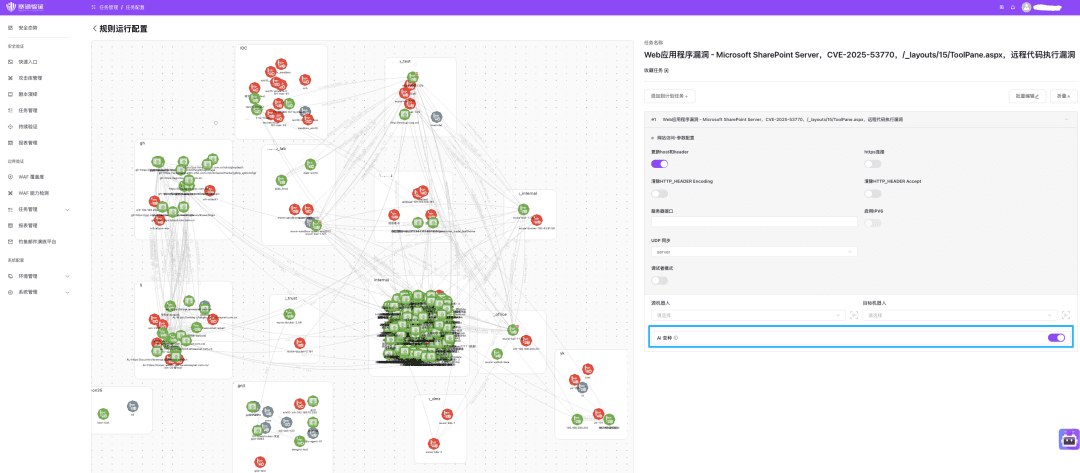
Without affecting normal business operations, the platform can realistically restore every link of the attack chain. From an attacker's perspective, targeting the enterprise's security defense system, it conducts adversarial validation and predictive attack simulation through an AI assistant, discovers protection shortcomings, and provides actionable mitigation, remediation, or supplement suggestions, truly helping customers build active defense capabilities and deploy defenses in advance.
Systematic Testing Based on the ATT&CK Framework
Based on the widely-adopted MITRE ATT&CK framework in the industry, the platform has built a complete attack library. It not only covers the complete attack lifecycle from initial intrusion to data exfiltration but also continuously tracks the latest global threat intelligence, timely incorporating emerging attack techniques into the attack library. Security teams can flexibly filter test cases by attack group, malware family, or attack technique, or customize and orchestrate complex multi-stage attack scenarios. The validation work can satisfy routine compliance requirements while also conducting special assessments for specific threat scenarios. Stepping into a New Stage of Intelligent Security Operations The new regulations of the Cybersecurity Law are set to be implemented on January 1, 2026, marking a new stage in China's cybersecurity construction. At this stage, merely deploying security products is not enough; more importantly, it is necessary to ensure that these security products are indeed effective. AI-driven security validation technology precisely provides the necessary technical support for this new era. It makes the originally invisible security effects visible, makes the hard-to-measure protection levels measurable, and moves security construction from experience to science. Under the guidance of the Cybersecurity Law, the new paradigm of security operations empowered by AI intelligent security validation makes security effects "visible". This is not only a compliance requirement but also an inevitable choice for security construction in the intelligent era. In the new regulatory environment, can your security system pass compliance checks and, more importantly, withstand real-world testing?


