AI Security and Intelligent Operations
The Evolution and Future of AI Security: In-Depth Analysis and Trend Outlook

Introduction: Security Challenges under the Wave of New Technologies
With the rapid iterative development of Artificial Intelligence today, AI technology is reshaping business models and operational paradigms of various industries at an unprecedented speed. According to the latest research data, the global AI market size is expected to break through USD 150 billion in 2025, reaching a compound annual growth rate of 38%. However, along with the deepening of AI applications, the security challenges they bring have also become increasingly prominent. From data breaches to model vulnerabilities, and from privacy protection to compliance risks, AI security has become a key issue that cannot be ignored in the process of enterprise digital transformation.
▌Current Status Analysis of AI Security

Current Status of Enterprise AI Adoption
The current adoption of AI technology by enterprises shows obvious stratified characteristics. According to Gartner's latest forecast, by 2026, 80% of enterprises will apply AI technology in their core businesses. However, this adoption process presents a significant "imbalance":
Leading the way are large technology enterprises. They are not only at the forefront of AI technology research, development, and application, but have also established a comprehensive AI governance framework, set up AI ethics committees, actively participated in the formulation of industry standards, and balanced application safety and compliance while ensuring technological advancement.
Although medium-sized enterprises are also striving to embrace AI, constrained by resources and talent, they often lack systematic planning and deployment. Currently, the AI applications of these enterprises are mainly limited to specific mature scenarios such as customer service and marketing recommendations. There is still much room for improvement in areas such as data governance and algorithm optimization, and challenges in security and compliance are also increasingly prominent.
Small enterprises are in the most difficult situation. Restricted by technology and financial strength, it is difficult for them to build their own AI teams and platforms. They can only passively rely on third-party generic solutions, which lack flexibility and are highly vulnerable to supplier "supply cuts." Even more worrying is that these enterprises have insufficient vigilance and related investment in AI security risks, making them easier targets for cyberattacks and data breaches. In the long run, they may face the risk of being eliminated by the "technological generational gap."

It is worth noting that although the "free procurement" style of introducing AI tools adopted by most enterprises has stimulated grassroots innovation vitality to a certain extent, it has also bred many hidden dangers, which is unfavorable to data integration, process coordination, and security management.
It is foreseeable that AI is bound to become the "winning formula" for all industries. Only by formulating feasible AI development strategies as soon as possible, solidifying technical capabilities, and balancing safety and ethical baselines can enterprises remain invincible in the wave of intelligence. This also relies on governments and industry organizations to improve the top-level design of AI governance, strengthen guidance and supervision, and create a good institutional environment for the in-depth application of AI technology in various fields. Major Security Challenges

1. Data Security Risks
In AI application scenarios, data security has surpassed the traditional CIA triad of confidentiality, integrity, and availability, presenting new characteristics: A. Uncontrollability of Data Flow Enterprise data may be acquired by third parties during AI training and inference. Cross-border data flows face legal and compliance risks. Data sharing and collaboration scenarios are increasing, blurring boundaries. B. Data Poisoning Risks The quality of training data directly affects the reliability of the AI model. Malicious data poisoning may cause model bias. The quality of data annotation varies. C. Data Compliance Requirements Privacy regulations such as GDPR impose strict requirements on AI data processing. Significant differences exist in data protection standards between different countries and regions. The rise of the concept of data sovereignty brings new challenges. The cost of non-compliance continues to rise, with global data compliance penalties exceeding USD 5 billion in 2023.

Studies show that 41% of enterprises consider data security as the primary consideration when adopting AI. This proportion is even higher in sensitive industries such as finance and healthcare, reaching over 60%.
2. AI Model-Specific Security Threats
AI models face unique security challenges, which are fundamentally different from traditional cybersecurity threats.
Challenge Type | Description | Examples/Details | Detection & Defense |
Adversarial Attack | Interfering with model judgment through carefully constructed inputs | Threats of physical world adversarial examples; model robustness issues; technical details include the evolution of attack methods such as FGSM, PGD, etc. | Adversarial example detection; model hardening; anomaly detection |
Prompt Injection Attack | Using special prompt words to bypass security restrictions | Security challenges faced by large language models like ChatGPT; potential social engineering threats | Prompt word analysis; security auditing; anomaly detection |
Model Reverse Engineering | Deducing model architecture and parameters through black-box testing | Intellectual property protection faces challenges; model theft risk rises | Access monitoring; behavior auditing; anomaly detection |
Training Data Poisoning | Planting backdoors during the training phase | Covert attacks affecting model behavior; supply chain security issues | Data cleaning; model auditing; anomaly detection |
3. Lack of Standards and Regulatory Differences Standards and Compliance Challenges Existing IT security frameworks struggle to fully cover AI-specific risks, such as model poisoning and adversarial attacks. Because the speed of technology development far exceeds the process of standard formulation, enterprises lack practical guidelines. Cross-industry AI applications lead to large differences in security requirements, making unified standards difficult to implement. Meanwhile, AI system decision chains are long and involve many parties, making responsibility definition complex, and there is also a lack of clear accountability mechanisms for discriminatory results caused by algorithmic bias. Cross-Border Regulatory Adaptation AI regulatory frameworks in different countries vary significantly; for example, the EU AI Act has different requirements compared to China's Administrative Measures for Generative AI. Restrictions on cross-border data flows affect model training and deployment, requiring enterprises to meet different compliance standards in multiple regions simultaneously. This not only increases operating costs but also brings challenges to globalized AI applications. It is recommended that enterprises plan their compliance capability building in advance and establish dynamic risk assessment mechanisms to ensure that AI applications both meet regulatory requirements and maintain innovation vitality.
▌Future Trends and Development Directions

Investment Trends
According to IDC's latest forecast, the AI security market will present the following characteristics by 2025: Market Size
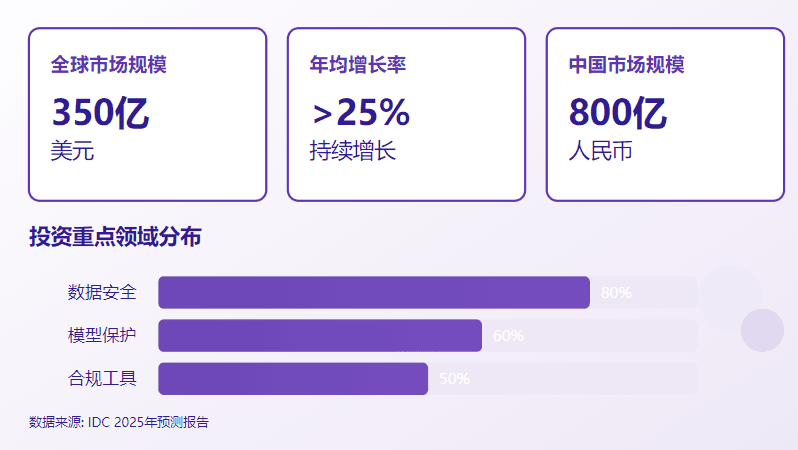
It is predicted that the global AI security market size will reach USD 35 billion by 2025, with an average annual growth rate exceeding 25%, of which the Chinese market is expected to break through RMB 80 billion. Enterprises will increase their investment in data security, model protection, compliance tools, and other fields. The proportion of large enterprises' AI security expenditure in their security budget will increase to 20%, and small and medium-sized enterprises are also starting to attach importance to it. About 60% of enterprises will deploy AI security monitoring platforms, and the Security as a Service model and open-source ecosystems are favored. In addition, new technologies such as federated learning, privacy computing, and verifiable AI will also be innovatively applied. In short, AI has become the "new blue ocean" of the digital economy, and enterprises need to incorporate it into their overall security strategy to guarantee sustainable business development. Enterprise Investment
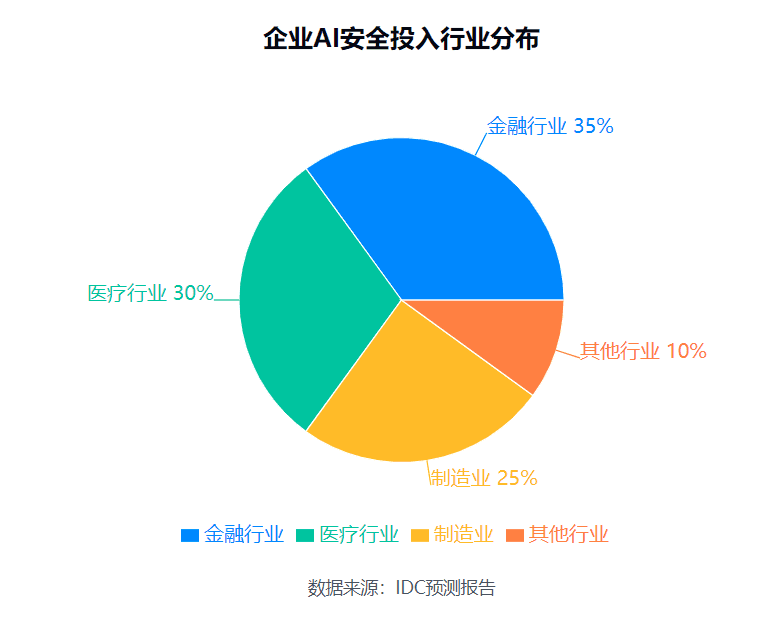
Forecast data shows that by 2025, enterprise spending on AI security solutions will grow by more than 15%, and the proportion of AI security in large enterprises' security budgets will increase to 20%. Small and medium-sized enterprises are also starting to value investment in AI security. Finance, healthcare, and manufacturing are the leading industries in AI security investment. This reflects that enterprises are placing increasing importance on AI security, which has become an important focus area for enterprise digital transformation and intelligent upgrades. Technology Layout

It is expected that by 2025, about 60% of enterprises that have adopted AI applications will deploy dedicated AI security monitoring platforms to achieve comprehensive risk monitoring and continuous control of AI systems. Meanwhile, with the popularization of cloud computing, the Security as a Service (SECaaS) model will also develop rapidly in the AI security field, enabling small and medium-sized enterprises to acquire required security capabilities in a more flexible and economical way. At the technical tool level, the open-source security tool ecosystem is expected to flourish further. The open-source model can promote collaboration and sharing among enterprises and lower the technical threshold of AI security. Open-source security frameworks and tools targeting specific scenarios will continue to emerge and improve. In addition, some innovative privacy protection and security verification technologies will also be applied in AI systems. For example, federated learning can enable model training without data leaving the local site; technologies such as formal verification and explainability will help enhance the auditability and trustworthiness of AI models. These technologies will complement traditional security methods to jointly build a solid AI security defense line. New Security Threats and Talent Transformation Trends With the rapid development of AI technology, the cybersecurity field is facing new challenges. In terms of threats, AI-driven intelligent attacks are becoming a major trend, including adaptive attack strategies and automated vulnerability mining. Meanwhile, the combination of traditional attack methods with AI has generated more complex mixed threats, increasing the difficulty of protection. At the infrastructure level, the widespread application of AI systems has also brought new security hazards, particularly in computing power platforms and edge computing scenarios. These changes are also driving the transformation of security talent demand. Future cybersecurity experts need to possess a composite knowledge system of both AI and security, and continuously improve their practical capabilities. Skill requirements are evolving from traditional single-dimension security protection to multi-dimensional development encompassing machine learning, security engineering, and risk management. Talent cultivation also focuses more on practical ability training, and the importance of internal training within enterprises and industry-university-research cooperation is increasingly prominent.
▌Scenario-Driven AI Security Protection Strategy

Deepening Protection in Financial Risk Control Scenarios
The core of financial scenarios is to build a real-time anomaly detection system. By deploying a VAE-based adversarial example detection engine and establishing confidence scores with multi-level thresholds, black-market attacks can be effectively intercepted. During the training phase, cluster-based anomaly sample identification is implemented, and a data quality scoring system including integrity, consistency, and timeliness is established. Meanwhile, through adversarial training and gradient clipping, model robustness is significantly enhanced.
Recommendation System Protection Innovation
The key to recommendation systems is to prevent model manipulation and data poisoning. In an innovative way, the Thompson sampling mechanism is introduced to bring in randomness, and diversity constraints are added through the MMR algorithm, effectively preventing the model from being maliciously guided. A collaborative cheating detection system based on Graph Neural Networks is deployed, session-level abnormal behavior identification is implemented, and a real-time data quality monitoring system is established to timely detect and handle abnormal behaviors.
Technical Protection System Upgrade
In terms of core technology, data security is protected through adaptive differential privacy schemes, with noise parameters dynamically adjusted based on data sensitivity. Semi-homomorphic and fully homomorphic encryption schemes are adopted respectively for different scenarios to ensure data security while guaranteeing performance. A complete key management and rotation mechanism is established to achieve full-process data protection.
Resilient Architecture Guarantee
Different from traditional static protection, a lightweight shadow system containing a rules engine is innovatively deployed as a downgrade backup plan. By monitoring key model indicators in real-time, rapid switching is executed when anomalies are detected to ensure business continuity. Meanwhile, a complete performance degradation warning mechanism is established to timely initiate processing flows before model effectiveness drops significantly.
Supply Chain Security Protection
With the standardization of AI components, supply chain security is increasingly important. Deep structural analysis and backdoor detection are implemented on open-source models, and version update security is continuously monitored. All-round security assessments and performance tests are conducted on third-party APIs, strict calling behavior monitoring is implemented, and a complete defense-in-depth system is constructed.
▌AI Security: The Only Way of Dynamic Evolution

As a dynamically evolving field, AI security is both a technical issue and a strategic choice. As a security expert said, "Security is not a product, but a process." Enterprises need to establish a continuous improvement security management system by building a comprehensive governance framework, adopting advanced protection technologies, and cultivating professional talents. Only by continuous investment and optimization from a dynamic and evolutionary perspective can enterprises ensure safety and controllability while seizing AI innovation opportunities, maintain a competitive edge in a rapidly changing technological environment, and ultimately achieve sustainable development.


