AI Security and Intelligent Operations
As AI Agents begin calling tools, security must not focus solely on the models

The scenario that security teams dread the most often occurs after an advisory is released, when people start digging into old accounts in the group chat: "Who set up this system?" "Who is using it?" "Which databases is it connected to?"
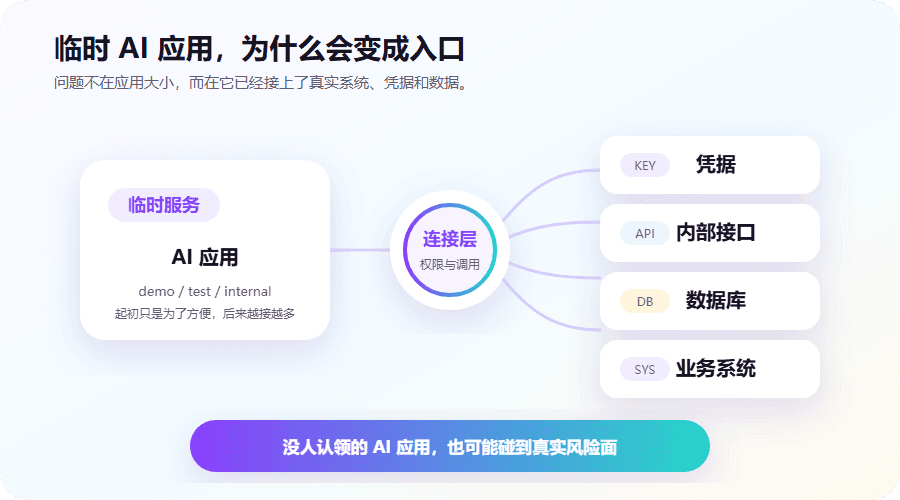
After asking around, no one can immediately provide an accurate answer. As the world's first fully automated AI ransomware attack, JADEPUFFER targets Langflow instances exposed to the public internet as its entry point. After exploiting a vulnerability to gain entry, the attackers began digging through configurations, searching for keys, hitting cloud credentials, scanning internal services, and finally pushing towards production servers and databases. The real gut punch is this: many links in the attack chain were actually AI applications and connections that the enterprise itself had spun up first and subsequently failed to continuously monitor and close. What usually looked like temporary services, test interfaces, and convenient troubleshooting tools became pathways in the attack chain.
01
Not a Sudden Awakening of AI, but Tools Becoming More Diligent
The breakthrough point of this incident was a set of open-source Langflow instances exposed to the public internet. As an LLM workflow builder, developers used it to connect models, API interfaces, and databases, which is indeed extremely convenient. However, the price of this "convenience" is that it instantly became a high-value topological connection point. As long as a platform can connect everything, it is no longer just a development aid—it holds API keys, database connection strings, and configuration files. Usually drifting outside the security radar, it becomes a natural entry point for the attack chain when an actual strike occurs.
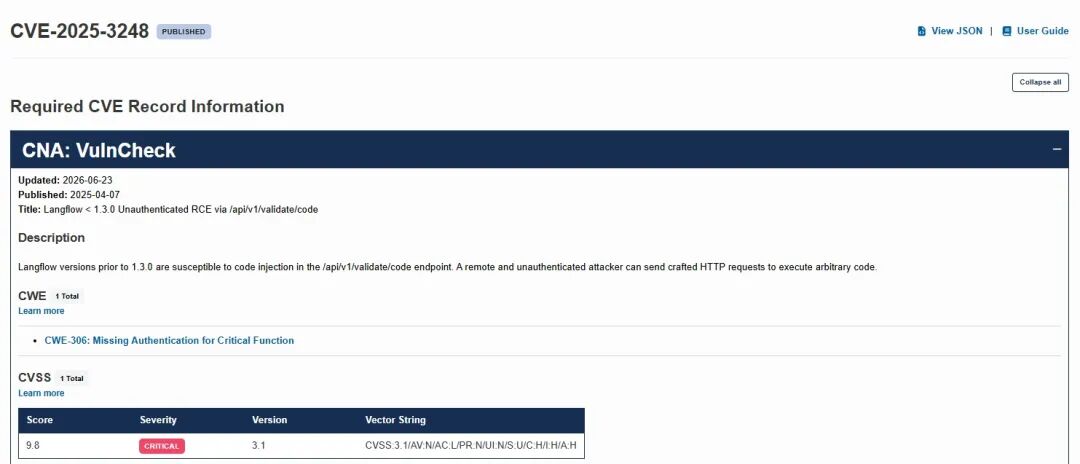
Image Source: https://www.cve.org/CVERecord?id=CVE-2025-3248
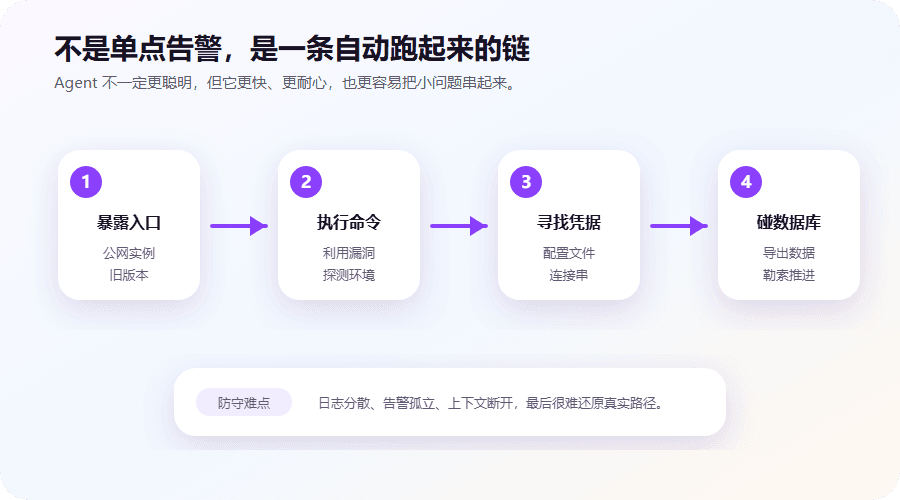
Entry Point: Publicly exposed Langflow instances
Vulnerability Exploitation: JADEPUFFER exploits CVE-2025-3248; the subsequently disclosed CVE-2026-33017 also points to an unauthenticated remote code execution risk in Langflow, affecting versions prior to 1.9.0.
Lateral Movement: Read local configuration → search for credentials → connect to internal databases → advance ransomware
Core Evolution: The attack process exhibits Agentic characteristics of automatic trial-and-error, result correction, and chained advancement
So there is no need to deify this. It's not like sci-fi movies where AI awakens on its own; it's more like an old entry point being repeatedly knocked on by a tool that is more diligent and less afraid of failure. Previously, it might have been humans slowly trying with scripts, but now part of the trial-and-error can be left to an Agent to run.
02
Most Shadow Assets Die from "Rushing to Meet Deadlines"
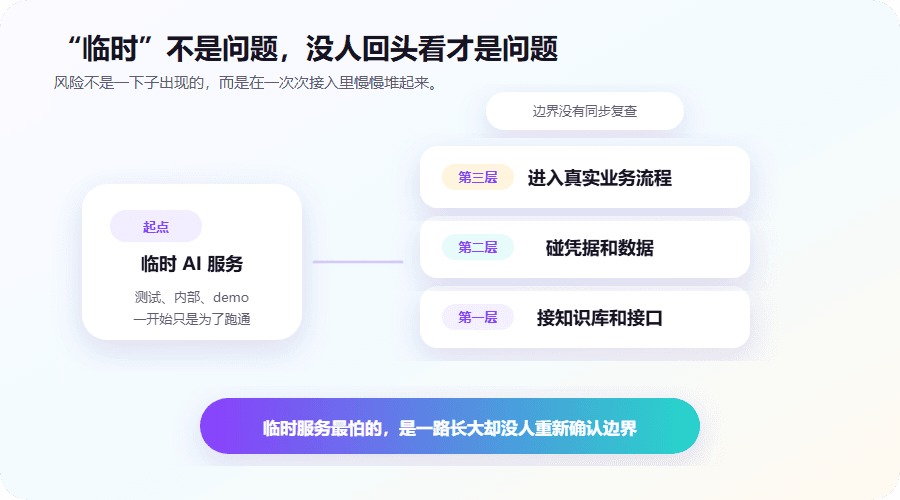
Within enterprises, most AI applications were not initially built as formal systems. To rush projects, R&D temporarily sets up a platform; to see the effects, the business side first opens a test service; to adjust parameters, ports are left open for a few days. Their labels are usually very simple: test, internal, demo. But in real-world confrontations, the most fragile boundaries are often "temporary." Temporary systems have no long-term monitoring, temporary accounts are not reclaimed in time, and no one remembers to close temporarily opened policies. The risk of AI application platforms grows wildly with each connection: first connecting models, then knowledge bases, then ticketing systems, and finally connecting to production databases. While functions go live along the way, security boundaries remain static. Attackers don't need sophisticated techniques; they are just the first to dig out these unclaimed entry points in the ruins left behind by rushed schedules.
03
Agents Don't Mind the Hassle, While the Operations Side Fears "Fragmentation" Most
Scanning the public internet, exploiting old vulnerabilities, reading configurations, and connecting to databases—these actions themselves are not new; what has really changed is the rhythm and density. Humans get tired and scripts break, but AI Agents do not. It can adjust its next step in real-time based on blocking feedback from security devices, switching directions if it fails, and retrying if it fails again. It doesn't need to be absolutely brilliant; as long as it is fast and patient enough, it can chain several scattered minor vulnerabilities into a deadly, one-way attack chain. The defense side's biggest headache is precisely this kind of fragmented misjudgment: the Web side captures a lightweight anomalous request, the host side sees a routine command execution, and the database side experiences a brief anomalous connection. In system logs, the risk score of each single-point alert is not enough to trigger a high-risk warning. When security devices speak their own languages and alerts sound individually, once the contextual chain is broken, even the real attack path cannot be reconstructed during post-mortem reviews.
04
What Needs Remedying Is Not Slogans, but Validation
This matter ultimately comes back to an old question: thinking we have protection and protection actually being effective are two different things. Whether AI application platforms are included in the asset inventory, and whether exposure scanning can discover them; Once hit, whether logs are left for command execution, configuration reading, and credential access; When an anomalous database connection occurs, whether the contexts of the entry point, account, host, and database can be linked together; Whether the steps of blocking the entry point, changing credentials, confirming impact, and retesting/validation can be fully executed. None of these are things that count just because they are written in policies. A more practical approach is to put such scenarios into a validation checklist. Instead of waiting for attackers to arrive before conducting a review, run through a close-to-real path in advance. See if entry points can be discovered, if alerts can appear, if analysts can understand the context, and if containment actions can be carried out.
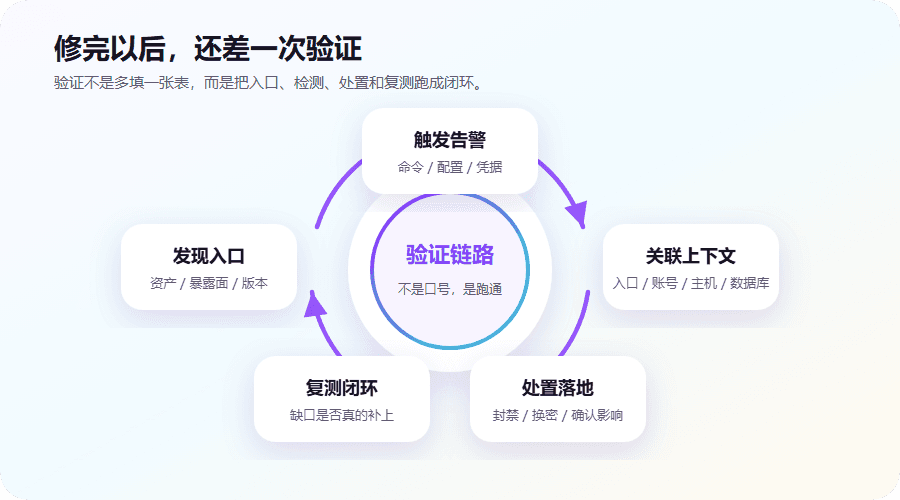
After running through it, the security team won't just have "already checked" to show for it, but a set of results that can be used to explain issues: which links are visible, which links fail to connect, which rules need to be supplemented, and which processes need to be modified. Such results are far more useful than a checklist with checkboxes.
05
AI Applications Must Also Enter the Inventory
AI applications, Agent workflows, and plugin services—as long as they touch business systems and hold real credentials, they are no longer "temporary services." R&D always thinks it's just a test. But in terms of technical indicators, whether entry points can be discovered, whether anomalous calls trigger alerts, and whether subsequent remediation can close the loop—these real confrontation data points tell a story much better than a paper-based go-live approval form. Put simply, AI itself is not the source of threats; those small, unowned, and untraceable entry points are. Instead of waiting for attackers to sneak in one day to help you "inventory assets," you might as well honestly put these authorized components into the validation checklist and test them first.
Reference Sources:
Overseas Cloud Security Research Team, 2026-07-01, Research Report on JADEPUFFER and Automated Database Ransomware.
The Hacker News, 2026-07-02, Coverage on Langflow Vulnerabilities and AI Agent Automated Attack Campaigns.
SecurityWeek, 2026-07-03, Coverage on Agentic AI Initiating Ransomware Attacks via Langflow.


