Threat Intelligence and Security Incidents
Scenario Playbook: Witnessing the Entire APT Attack Process, From Intrusion to Data Leakage

In the world of cyber security defense, predicting and simulating actual attack scenarios is crucial. This not only helps security teams understand and prevent potential threats, but also enhances their ability to respond to complex attack patterns. Lexfo Security Metrics Validation Platform helps enterprises better validate and strengthen their security defense systems through first-hand victim threat intelligence.
Playbook execution further increases the usability of this threat intelligence, transforming it into intuitively visual attack behaviors, paths, and strategies, especially with detailed disassembly of complex attack patterns, enabling security teams to more effectively understand and counter Advanced Persistent Threats (APTs).
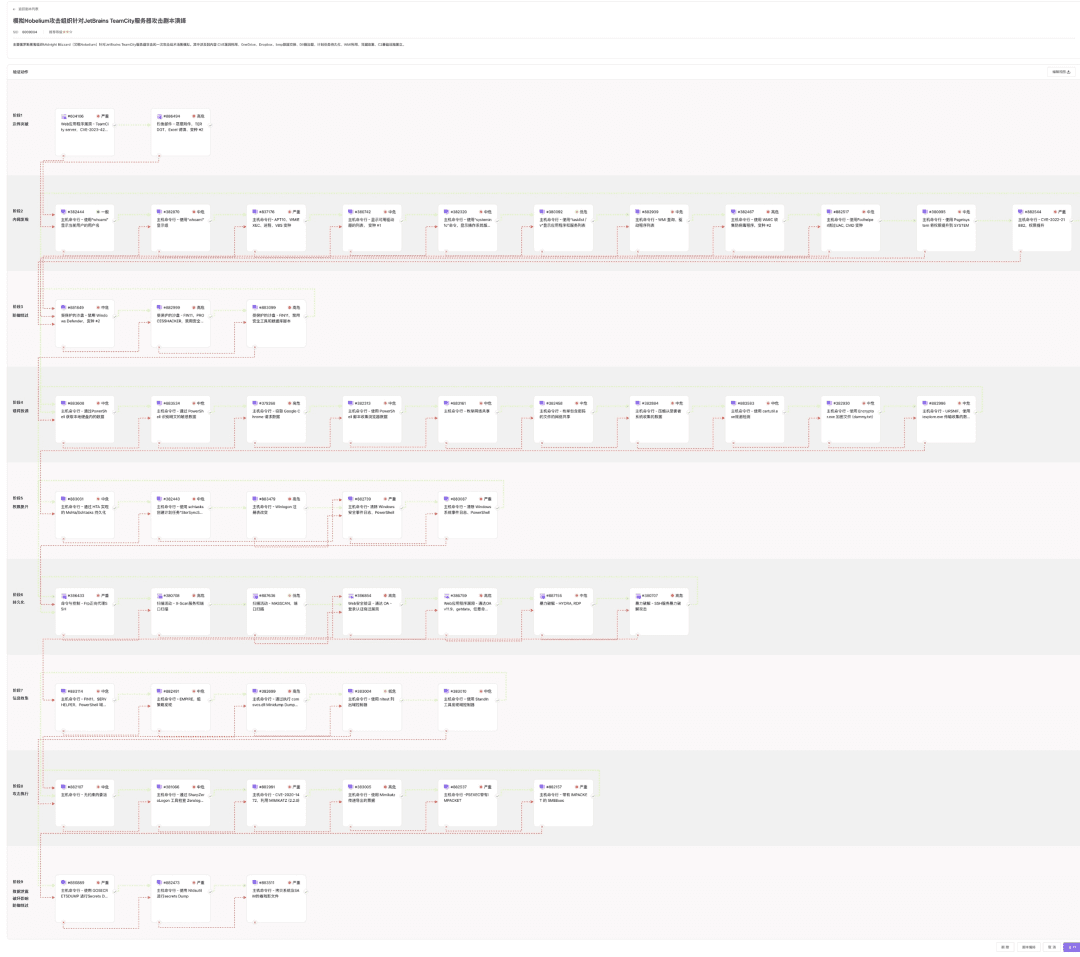
▌ Playbook Execution Application Example: Reconstructing the Detailed Attack Steps of the OceanLotus (APT32) Group
Taking the well-known APT group — OceanLotus (APT32) as an example, the following is a full-process simulation of the detailed attack techniques used by the group in an attack incident in 2021.
▶ Attack Background
APT32, also known as OceanLotus, is an advanced persistent threat group based in Vietnam, whose activities encompass espionage and information theft. In 2021, the group executed a series of cyber attacks targeting international news agencies with the goal of stealing sensitive information and monitoring journalists' activities.
▶ Attack Process
Phase 1: Boundary Breach: Simulates APT32 obtaining initial access through phishing emails. The email contains a malicious link or attachment which, once clicked or downloaded, allows the attacker to plant malicious code.
Phase 2: Intranet Discovery: Using the obtained initial access, simulates the attacker moving laterally within the network to find targets of higher value.
Phase 3: Defense Evasion: Simulates the attacker taking measures to bypass security defense mechanisms, such as disabling security software and modifying system logs, to avoid detection.
Phase 4: Payload Delivery: Attackers deploy specific malware or tools into the target network, laying the groundwork for further malicious activities.
Phase 5: Privilege Escalation: By exploiting system vulnerabilities or using stolen credentials, attackers elevate their privileges on the compromised systems.
Phase 6: Persistence: Attackers install backdoors or other mechanisms on compromised systems to ensure they maintain control over the victim's network even after system reboots.
Phase 7: Information Gathering: In this phase, attackers collect sensitive data, such as internal communications, financial records, and personal information, in preparation for eventual exfiltration or sabotage.
Phase 8: Attack Execution: Utilizing the gathered information and elevated access privileges, attackers execute specific destructive activities, such as data tampering or further network penetration.
Phase 9: Data Exfiltration & Impact & Defense Evasion: In the final phase, attackers exfiltrate stolen data to control servers and may carry out destructive actions before exiting the system, such as deleting critical files or bypassing newly deployed defense measures again, to hide traces of the attack.
▌ The Profound Value of Playbook Execution
Simulating Real-World Attack Strategies: Playbook execution allows security teams to construct and simulate complex attack scenarios based on real-world attacker behaviors and strategies. In this way, teams can evaluate the effectiveness of specific security defenses against real threats.
Education and Training: Playbook execution is not only a testing tool but also an educational one. It helps security teams understand and learn the various tactics and techniques attackers may employ, thereby enhancing the security team's attribution capabilities, response capacity, and the depth of strategic planning.
Visualizing Attack Paths: Through the playbook execution function, attack paths and activities at various stages can be visualized, enabling the security team to intuitively see the process of how an attack occurs. This visualization helps the team better understand how an attack gradually penetrates and expands, which defense measures are actually effective, and which need improvement.
Testing and Optimizing Security Strategies: Playbook execution can validate the effectiveness of specific security strategies and measures, helping security teams optimize security configurations. Additionally, by continuously running different attack playbooks, security strategies can be continuously improved and adjusted to adapt to new or evolving threats, allowing for proactive defense.
Enhancing SIEM/SOC Use Cases: Adding use cases that analyze correlations based on attack contexts within Security Information and Event Management (SIEM) or Security Operations Centers (SOC) improves the accuracy and efficiency of incident response.
Addressing Unknown Threats: By simulating the latest attack techniques or attack vectors that are not yet widely recognized, playbook execution helps security teams prepare for and counter unknown threats. This proactive testing is difficult to achieve with traditional security testing methods.
Through playbook execution, enterprises can not only evaluate, reinforce, and optimize strategies for security measures, but also adapt to the continuous evolution of cyber threats through continuous simulation testing, thereby maintaining the foresight and effectiveness of security defenses, raising awareness and response speed to security threats across the entire organization, and bringing continuous business and security value to the enterprise.


