Security Verification and Offensive-Defensive Practice
Are risks resolved once VPN vulnerabilities are patched?

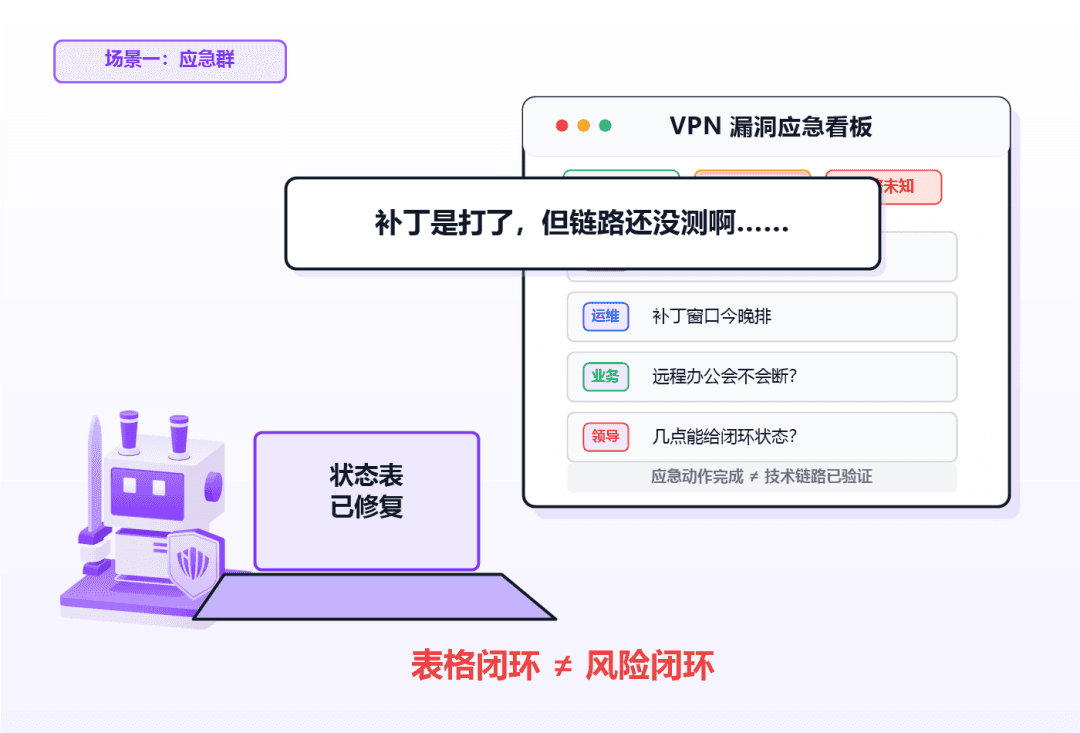
Just past 4 p.m., the security team received a VPN vulnerability advisory. It was the same old routine: confirm affected versions, create a group chat, hunt down assets, notify system owners, coordinate maintenance windows, and push for patches. Messages in the group chat were flashing rapidly. Operations asked if it would affect remote working, the business department asked if they could hold off on changes for the day, and leadership wanted to know by what time tonight they would get a status update.
Without realising it, time slips away, and the issue might not even be resolved quickly.
This is a scenario all too familiar to many security teams.
Several recent vulnerabilities related to VPNs and remote access have once again brought this age-old issue back to the forefront.
BleepingComputer reported on 8 June that CVE-2026-50751, a vulnerability in a mainstream VPN / remote access product, has already been exploited in zero-day attacks and linked to Qilin ransomware campaigns.
The Next Web also mentioned on the same day that this vulnerability had been exploited for about a month before the patch was released.
During the same round of investigations, CVE-2026-50752 was also disclosed: it similarly relates to the legacy IKEv1, affecting certificate validation in site-to-site VPN scenarios, and could potentially be exploited for man-in-the-middle attacks under specific conditions. Looking further back, another mainstream remote access product disclosed an authentication bypass vulnerability, CVE-2026-0257, in mid-May.
The vendors and products may differ, but the underlying issue remains highly similar: once an authentication bypass occurs at the perimeter access point, security teams cannot treat it as "just another patching task."
01
What Happened?

Let's look at the dossier first for a quick 30-second overview:
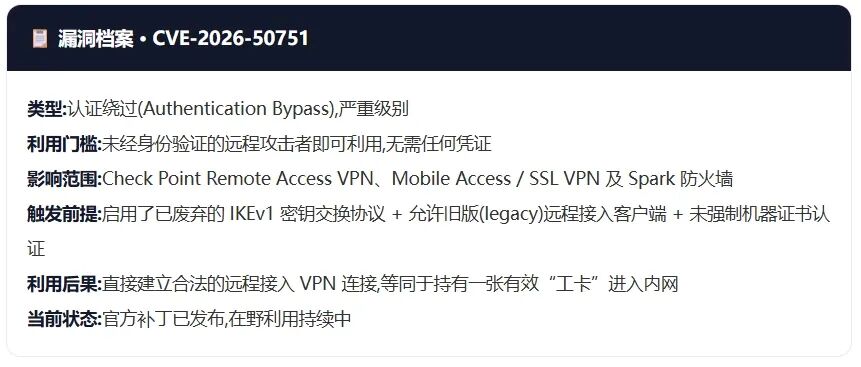
Note that these are all VPNs and authentication bypasses—not weak passwords, nor credential stuffing. Attackers don't need to guess your passwords because the access control validation logic itself can be bypassed.
No matter how strong your password policy is or how diligently you rotate passwords, they are completely irrelevant in the face of this vulnerability.

In other words, there was a one-month "silent window" between the attacker's exploit and the defender's awareness. During this month, the victim enterprises' security equipment operated completely normally—at least, that is what the dashboards displayed.
But anyone who has actually handled incident response knows that this is often the most awkward and uncomfortable phase.
Was the anomalous login detected? If the attacker had already breached the network before the patch was released, can the SOC correlate these signals?
02
A Closed Loop on Paper is Not a Closed Loop on Risk

Many enterprises have very mature vulnerability response workflows.
They have group chats, templates, asset inventories, designated owners, and timeline milestones. Once remediation is complete, the security team collects the forms, aggregates the data, takes screenshots, and sends out reports. Externally, it looks highly complete and robust.
But the more incident responses you handle, the more you realise that taking a vulnerability from "notified" to "remediated" only completes the management process. Whether the actual risk is truly mitigated depends on whether the technical pipeline has successfully run its course.
For instance, a certain VPN might indeed be patched, but old protocols are still left active in the configuration;
A specific remote access port may indeed be closed, but the backup link was never included in the asset inventory;
A VPN login log may indeed have reached the platform, but it was never correlated with anomalous IPs, unusual accounts, or internal network access behaviours;
A password reset may indeed have been enforced on an account, but whether the attacker had already harvested credentials and attempted lateral movement is something no one can say for sure.
This is not due to a lack of effort from the security team.
Rather, critical vulnerability response is inherently driven by tight timelines. The business department demands quick restoration, leadership wants progress updates, operations require maintenance windows, and the security team is caught in the middle. Consequently, it is easy to default to treating "completed actions" as the milestone objective.
But attackers do not look at spreadsheet checklists.
They only look at whether the entry point is still open, whether they have sufficient privileges, and whether anyone is responding to the alerts.

03
Why VPNs Are Truly Sensitive: They Stand on the Perimeter

Why do VPN vulnerabilities always keep security teams on edge?
Because it is not just a minor vulnerability in an ordinary business system. It stands on the perimeter, behind which lie identities, endpoints, servers, file shares, domain controllers, and backup systems.
Once an attacker enters through a remote access point, their subsequent actions rarely stop at the VPN device itself. The rhythm of many ransomware attacks is straightforward: find the entry point, harvest credentials, move laterally, and finally, execute encryption and extortion.
Therefore, when responding to VPN vulnerabilities, one cannot simply ask, "Has the patch been applied?"

Instead, we should ask:
Can anomalous access be detected?
Does a suspicious account login trigger an alert?
Is lateral access detected after remote entry?
Did the security devices generate valid logs?
Can the SIEM/SOC correlate these signals into an attack chain and trigger an alert?
Can the response workflow seamlessly transition from an alert to a ticket, blocking, password resets, and retesting?
These questions are hard to answer confidently if you rely solely on manual recollection.
What security teams dread most is not discovering a loophole, but having to answer the leadership's question "Are we secure now?" with: "It should be fine."
In cyber security, the word "should" is often extremely expensive.
04
After Remediation, One Final Validation is Still Needed
In recent years, everyone has been talking about vulnerability management, attack surface management, and exposure management. Tools are multiplying, and asset lists are growing longer.
But what many enterprises lack is not lists.
What they lack is proof.
Which risk can actually be exploited to compromise the system?
Which patch actually blocked the threat?
Which rule actually triggers an alert?
Which response workflow actually runs successfully end-to-end?
Scenarios like VPN zero-days are particularly suited for re-evaluation through security validation.
Rather than waiting to conduct a post-mortem after an attacker has breached, you should run through near-real-world validation scenarios right after patching the vulnerability.
Simulate anomalous remote access to see if perimeter devices and log platforms record it;
Simulate lateral movement following a suspicious login to see if detection rules react;
Simulate audit logs entering the SOC to see if existing correlation rules can trigger an alert after obtaining enough context for correlation analysis;
Simulate the response workflow to see if ticketing, blocking, password resets, and retesting form a closed loop.
Once completed, the security team will have far more than just a "remediated" status; they will possess a set of results that tell a much clearer story:
Which phases can block the attack;
Which phases are visible;
Which phases still need patching;
Where can we react faster when a similar vulnerability strikes next time.
This is where the true value of vulnerability response lies.
05
From "Remediated" to "Proven"

This type of validation is difficult to sustain reliably over the long term if it depends on ad-hoc group chats and manual recollection. It needs to become a repeatable, measurable, routine practice.
Security validation is not about adding another layer of bureaucracy to the incident response workflow. Instead, it helps security teams test the actions that usually "appear to have been completed" in practice:
Can the attack get in? Does the alert trigger? Can analysts understand it? Can remediation actions be executed? The CyWall Security Validation Platform puts these critical questions into repeatable validation scenarios.
It is not about generating another spreadsheet for the team, but about providing a layer of evidence behind "remediated."
Businesses cannot stop using VPNs, remote access cannot simply be shut down permanently, and zero-day vulnerabilities will always exist.
What we truly need to watch out for is when everyone breathes a sigh of relief once the patch is applied, but no one asks the next question: If an attack actually happens, can we see it? Can we detect it? Can we handle it?
For security teams, the end of incident response should not just be "remediated."
Rather, it should be: We have validated it, and it indeed holds the line.
When you handle VPN or perimeter device incident response today, to what stage do you validate? Leave a comment and share your thoughts—do the words "assume" and "should" still linger in your operations?


