Security Verification and Offensive-Defensive Practice
Is the frontend dead? React Server Components hit by Remote Code Execution; Cyritex attack library updated in real-time

For a long time, there has been a tacit understanding in the security circle: the security issues of front-end frameworks, at most, are just XSS. As long as Cookies are well protected and cross-origin policies are configured correctly, no matter how much the front-end code is tinkered with, it is difficult to directly threaten the heart of the server.
But with the rise of meta-frameworks like Next.js and Remix, and the full rollout of React Server Components (RSC), this defensive logic is failing. In pursuit of ultimate rendering performance, JavaScript logic that originally ran in the browser is being migrated to the server side on a large scale.
When code in the browser starts running on the Server side, Pandora's box is opened.
On 3 December 2025, the disclosure of CVE-2025-55182 sounded an alarm for all full-stack development teams. This is not just a vulnerability, but a growing pain that must be experienced during the evolution of Web architecture—the React Server Components Remote Code Execution (RCE) vulnerability.

Why is it called "nuclear-level"?
This brings us to the "Flight" protocol introduced in React 19.
Simply put, to allow seamless communication between server components and client components, React invented a complex serialization mechanism. The server serializes the component tree, data, and even certain closure states, and sends them to the client to be revived.
This is where the problem lies. CVE-2025-55182 exposes a fatal oversight in how React handles Server Actions, where the deserialization logic lacks sufficient type validation.
Attackers do not need administrator privileges, nor do they even need to log in. They only need to send a carefully constructed binary stream in the format of the RSC protocol to the server. Hidden in this seemingly normal data stream is a malicious prototype chain.
Once the Node.js process on the server side attempts to parse this data, the malicious JavaScript object will be instantiated and executed in memory.
This is not a pop-up window; it's getting a Shell directly.
Once successfully exploited, the attacker obtains not only code execution privileges, but also the key to the intranet. As we all know, Next.js servers usually hold core secrets such as database connection strings and third-party API keys. Breaching this layer means that the door to the enterprise's core data assets is completely wide open.

The Vacuum of Defense
The 24 to 72 hours after the vulnerability disclosure is the most active window for attackers and the most anxious moment for enterprises.
Operations and security teams are faced with three very tricky practical problems:
Can we block it? Most existing WAF rules are based on traditional HTTP parameters or SQL injection features. For this kind of serialized Payload encapsulated in the Flight protocol, most WAFs cannot understand it, making it extremely easy to bypass.
Are we affected? Modern front-end engineering dependency trees are extremely complex. It may be hard for you to determine immediately which version of Next.js in your business line introduced the affected
react-server-dom-webpack.Do we dare to upgrade? Upgrading basic framework versions usually means huge regression testing costs, and direct patching is not immediately actionable in many production environments.
During this vacuum period, guessing is the biggest risk. You need exact verification.

Security Validation Labs: More Than Just Replication
As soon as the vulnerability intelligence was made public, Security Validation Labs did not just simply record the CVE number, but immediately initiated a reverse engineering analysis targeting the React Flight protocol.
We successfully replicated the entire process of vulnerability exploitation, extracted multiple variant Payloads, provided tested exploitation methods targeting this vulnerability to our VIP users at the first opportunity, and updated them in a timely manner to the attack library of the Security Validation platform according to our weekly update mechanism.
This is not just a static rule update.
Based on our AEV (Adversarial Exposure Validation) technology, we provide enterprises with a validation method from an attacker's perspective. This is completely different from traditional vulnerability scanning—we are not scanning version numbers, but simulating real hacker behaviour.
Users can now run targeted validation for CVE-2025-55182 on the Security Validation platform:
Harmless Simulation: We will send traffic with real attack characteristics from the source validation node in your environment to the target validation node, without needing a target machine, nor needing to send attack payloads directly to business applications. This verifies whether your perimeter defenses can detect and block this attack, and confirms whether the virtual patches you enabled on security products are effective. This ensures the safety of validation in production environments, without causing real service downtime or other impacts.
Full-Link Verification: Through attack path design (from outside to inside, from inside to inside, etc.), traffic can reach the validation nodes in all areas of the React server via your firewalls, WAF, IPS, and RASP.
The Truth Revealed:
If the WAF does not trigger an alarm, it indicates that your perimeter defense has failed due to protocol obfuscation.
If you indeed have a 1:1 test server, and you send an attack payload targeting this test server, and the test server responds with a specific echo, it indicates that your business code indeed has the risk of RCE.
Security defense should not be a gamble. Verifying the defense line first with real-world attacks is currently the lowest-cost and most certain assessment method.
At present, the validation rules related to CVE-2025-55182 have gone live on the Security Validation platform.
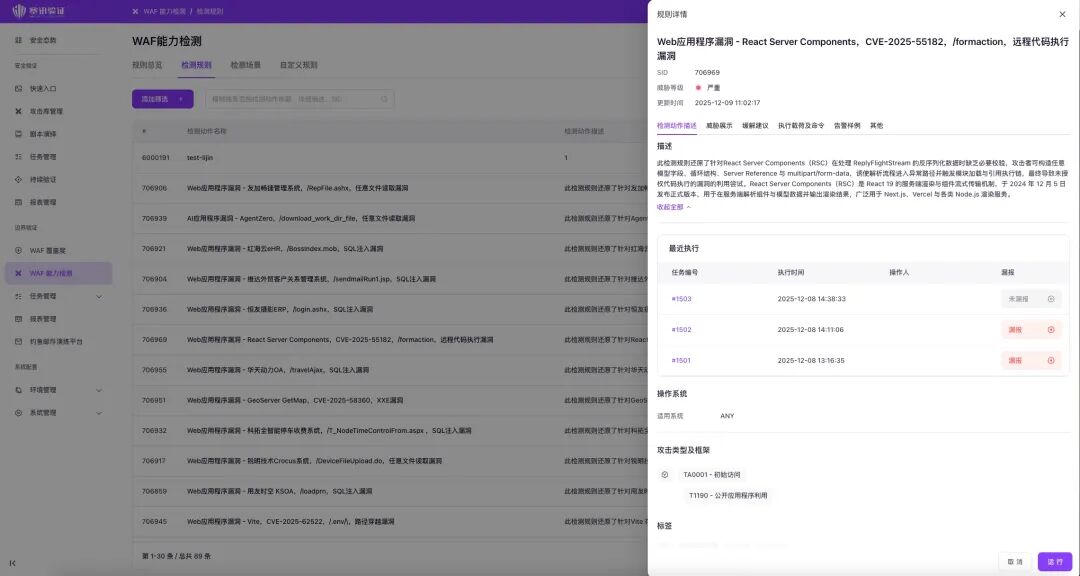
We suggest all enterprise users using React Server Components / Next.js to conduct self-inspections immediately. Before hackers formally knock on the door, let your own people try the door locks first. This is not just validation, but setting up defenses in advance. Instead of waiting for patches in anxiety, it is better to take action now and see your own hand.


