Security Verification and Offensive-Defensive Practice
How to Plan Your 2025 Enterprise Cybersecurity Budget: A Practical Guide from Investment Strategies to Precise Allocation

In the wave of digital transformation, cyber security budget optimization has become a critical issue that enterprise executives must face directly. As challenges from supply chain risks, data security, and business continuity arrive one after another, the traditional budgeting mindset of "heavy on deployment, light on operations" and "building step-by-step according to routine" has struggled to cope with increasingly complex security challenges.
▌Deconstructing 2024: Dilemmas and Reflections on Cyber Security Investment

After Micron Technology was included in the "Unreliable Entity List", many Chinese enterprises realized that the importance of supply chain security has exceeded the scope of traditional cyber security. This is not just a supplier admission issue, but also involves how enterprises can build a comprehensive security protection system in the digital era. According to the latest report from relevant institutions, the number of security vulnerabilities in critical information systems increased by 28.4% year-on-year, with more than 40% of these vulnerabilities directly related to supply chain links. This data sends a clear signal: enterprises must rethink the direction and structure of their security investments.
The current dilemma in security investment is mainly reflected at three levels:
First is the blind spot in budget allocation. A large number of enterprises still spend more than 80% of their security budget on purchasing security equipment, while investing insufficiently in critical areas such as security operations and talent training.
Second is the difficulty in quantifying investment outcomes, as enterprises generally lack a scientific evaluation system to measure the actual returns of their security investments.
Lastly is the constraint of talent resources. According to data from the Ministry of Education, by 2027, the gap in cyber security personnel in China will reach 3.27 million. The scale of graduates from undergraduate majors related to cyber security is far from meeting market demands, making the traditional approach of relying solely on expanding security teams unsustainable.
▌New Mindsets on Security Investment in the Digital Era

As enterprise digital transformation deepens, the mindset for cyber security investment must also evolve with the times. The traditional passive, defense-oriented investment model is shifting toward an active, evolving model, and this shift is reflected across multiple levels:
From Single-Point Protection to Overall Resilience
Traditional security investments often focus too heavily on building single-point protection capabilities, but in today's complex threat environment, this approach is showing obvious limitations. Research shows that in major security incidents occurring in 2023, more than 65% were caused by the accumulation of multiple weak links, rather than the failure of a single protection point. This indicates that enterprises need to shift the focus of their security investments toward building overall security resilience.
Building security resilience requires simultaneous efforts in four dimensions:
Technical Resilience: Constructing a multi-layered, degradable, and rapidly recoverable technical architecture
Operational Resilience: Establishing a flexible and efficient security operations system
Personnel Resilience: Improving the team's emergency response and continuous operation capabilities
Business Resilience: Ensuring critical business operations can maintain basic functioning even when under attack
From Passive Compliance to Security Empowerment
Compliance construction was once the primary driver of security investment for many enterprises. However, in the digital economy era, security investment should shift toward empowering business innovation. According to data from the Ministry of Industry and Information Technology, more than 40% of enterprises faced obstacles when launching digital innovation projects due to security issues, showing that traditional passive compliance-type security investments can no longer satisfy business development needs.
The concept of security empowerment requires enterprises to restructure their security budgets:
Basic security capability construction remains important, but its proportion should be controlled within 25-40% of the total budget
Increase investment in security for new technologies, such as cloud-native security, API security, container security, etc.
Reserve 15-20% of the budget to support security requirements during business innovation, such as LLM application security
Ensure there are sufficient resources for security operations and outcome validation
▌The Scientific Path to Budget Optimization
Through in-depth research into the security construction practices of nearly one hundred Chinese enterprises, we found that successful cyber security budget optimization generally follows an "Evaluation - Allocation - Validation - Optimization" closed-loop system.
The core of this system is to deeply bind security investment with business development, ensuring that every dollar invested produces actual protection value.
01/ Reconstructing Asset Classification and Risk Assessment Systems

Traditional asset classification often becomes a mere formality, whereas truly effective asset classification should serve as the compass for enterprise security construction. Although MLPS 2.0 "Information security technology—Baseline for classified protection of cybersecurity GB/T 22239-2019" provides us with a basic framework, how can we make this framework truly effective? The key lies in deeply binding the assessment system with business development.
In the practice of a large manufacturing enterprise, they innovatively proposed a "Dynamic Asset Assessment Mechanism": instead of simply grading systems, they established a multi-dimensional assessment system covering business value, data sensitivity, external dependencies, and threat exposure.
This assessment system is not static; it can adjust dynamically alongside business development. For example, when a certain business system needs to open up interfaces to the outside, its risk level will automatically rise, triggering corresponding security investment adjustment mechanisms.
By implementing the "Four-Dimension Assessment Method", enterprises can build an assessment system that truly reflects business security needs:
Business Impact: Besides assessing the direct impact of systems on business continuity, it is also necessary to analyze the supporting role of data in decision-making, as well as the complex dependencies among systems. A seemingly minor internal auxiliary system might have security protection requirements far exceeding expectations because its data supports core business decisions.
Data Sensitivity: Assessment in this dimension needs to break through traditional classification thinking, organically combining privacy protection, business secrets, and compliance requirements. Especially with the Data Security Law and related regulations becoming increasingly strict in recent years, enterprises need to assess the sensitivity level of data assets more cautiously.
External Dependencies: Assessment in this dimension is particularly critical. Supplier substitutability, technical support assurance capabilities, and reliance on third-party services will all directly affect the overall security of the system. Just as the Micron Technology incident warned, supply chain security has become an important factor that cannot be ignored.
Threat Exposure: This dimension requires comprehensive consideration of the system's external services, historical security incident statistics, and the actual effectiveness of current protection capabilities. This requires enterprises to establish continuous security monitoring and assessment mechanisms, rather than relying solely on annual security inspections.
02/ Refined Management of Budget Allocation

Budget allocation should not be a simple numbers game; rather, a scientific allocation mechanism needs to be established. According to research by the China Academy of Information and Communications Technology, the proportion of security budgets varies significantly among enterprises of different sizes, ranging from 8-12% for large enterprises to 3-6% for small enterprises. But what is more important is how to optimize the internal structure of the budget so that it can support the enterprise's security needs to the greatest extent.
We recommend adopting the "4+1" model to achieve refined budget management. This model not only considers basic protection needs but also reserves reasonable space for capability building, innovation support, compliance investment, and emergency response:
Basic Protection Investment (25%) should focus on the integrity and effectiveness of the protection system, rather than simply piling up security equipment. This requires enterprises to make reasonable configurations in cyber security infrastructure, terminal security protection, data security protection, etc., to ensure the comprehensiveness and reliability of basic protection capabilities.
Capability Building Investment (25%) needs to look toward long-term development. The construction of security operations centers, the enhancement of threat detection and response capabilities, and the deployment of automation tools should all be included in this scope. It is particularly worth noting that this part of the investment includes not only technical construction but also the cultivation and improvement of team capabilities.
Innovation Support Investment (20%) is key to keeping enterprise security construction dynamic. This portion of the budget should be used for new technology research, security support for business innovation, and protection capability enhancement. In the wave of digital transformation, those enterprises that can proactively layout security innovation often gain an edge in the competition.
Emergency Reserves (15%) are the "trump card" for enterprise security construction. This portion of the budget should be used not only for incident response but also to meet demands in expert technical support, procurement of emergency services, and other aspects. In actual operations, this part of the budget is most easily ignored or diverted, but it is precisely the last line of defense for enterprises against major security risks.
Compliance Investment (15%) remains indispensable, as it is a necessary condition for business operations. Of course, the proportion will vary greatly depending on different industries and enterprise sizes, and dynamic adjustments should be made based on one's own situation in actual operations.
03/ Continuous Outcome Validation and Optimization

Validating the outcomes of security investment has always been a difficult problem, but it is precisely the key link to ensuring the maximization of budget value. Establishing a scientific outcome validation system requires simultaneous efforts from three levels: technical, management, and business:
Technical Outcome Validation should be built upon objective data. Regular security assessments and penetration tests are necessary, but more importantly, a continuous monitoring system should be established to reflect the outcomes of security protection in real-time. This requires enterprises to invest effort in building a security measurement system, quantifying various security indicators to form measurable and comparable evaluation standards.
Management Outcome Validation needs to focus on the actual effectiveness of policy execution. Improvements in security awareness and process optimization should have specific measurement standards. For example, the security awareness level of employees can be assessed through regular security drills and phishing email tests; the actual effectiveness of security management systems can be evaluated through process audits and efficiency analyses.
Business Value Validation is the most challenging part, yet it is also the link that best demonstrates the value of security investment. This requires enterprises to establish a correlation analysis mechanism between security investment and business development, measuring the value of security construction through specific business metrics. For instance, the business value of security investment can be quantified by analyzing the impact of security incidents on business operations and the support of security construction for business innovation.
The establishment of a Continuous Optimization Mechanism is the guarantee for maximizing budget efficiency. It is recommended that enterprises establish a quarterly review system to regularly evaluate and adjust the outcomes of security investments. During this process, special attention should be paid to gathering feedback from all stakeholders, including business departments, IT operations teams, and security teams, to ensure the optimization direction aligns with the overall interests of the enterprise.
Based on the above theories, we have proposed a scientific budget optimization methodology, providing enterprises with a complete set of budget optimization tools:
BDEV Risk Assessment Model: A risk analysis framework that comprehensively evaluates enterprise assets based on four dimensions: Business impact, Data sensitivity, External dependencies, and threat exposure (Vulnerability).
4+1 Budget Allocation Model: A budget allocation methodology that scientifically divides an enterprise's cyber security budget into four main directions: basic protection (25%), capability building (25%), innovation support (20%), emergency reserves (15%), plus compliance investment (15%).
ROSI Outcome Validation System: A quantitative assessment method based on Return On Security Investment, which validates the actual benefits of security investment through three levels: technical outcomes, management outcomes, and business value.
Enterprises can refer to the detailed scoring standards and reference comparison tables in the appendix, and apply them flexibly according to their own actual conditions.
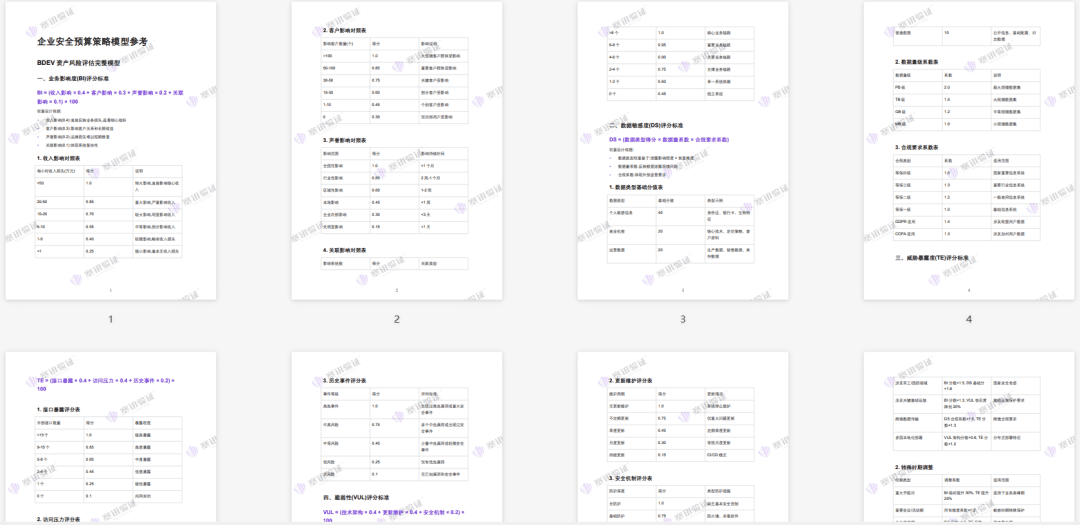
Reference Model for Enterprise Security Budgeting Strategy
Standing at the juncture of 2025, enterprise cyber security investment will display distinct technology-driven and operational transformation features. Investments will continue in zero-trust architectures and cloud-native security, while API security, supply chain security, security capability serviceization, and intelligent operations will become mainstream investment trends, with AI security gradually entering security investment budgets. At the same time, the need for industrial chain security collaboration and threat intelligence sharing will drive enterprises to continuously increase investments in ecosystem construction. It is expected that by the end of 2025, more than 60% of enterprises will achieve intelligent transformation of security operations, and more than 50% of security capabilities will be delivered in the form of services.
To this end, we recommend that enterprises strengthen long-term planning at the strategic level, focus on self-developed capability building, and promote deep integration between security and business; at the tactical level, optimize resource allocation, strengthen outcome validation, and improve automation levels. Only by maintaining an open and enterprising mindset, actively embracing changes brought by new technologies and concepts while ensuring necessary protective investments, can enterprises build a security assurance system that matches business development and safeguards their digital transformation.


