Security Verification and Offensive-Defensive Practice
Gartner Security Leader's Guide: How to Build an Effective Cyber Risk Management Framework

With the deepening of digital transformation, cybersecurity risks have become critical issues that enterprises cannot ignore. According to the 2024 Gartner Board of Directors Survey, 84% of respondents believe cybersecurity risk is a business risk, not just a technical issue. However, although many enterprises have invested significant resources in cybersecurity, only 17% of respondents believe their security investments have yielded clear results. The complexity of cyber risk management and the gap in execution have prompted enterprises to rethink and optimize their cybersecurity strategies. This article, combined with Gartner's "The Cyber-Risk
Management Cookbook
for Security Leaders", provides an in-depth analysis of how to build an efficient cyber risk management system to ensure that enterprises have sufficient capability to cope with cyber threats.

▌Current Status of Cyber Risk Management
Cyber risk management, simply put, refers to preventing cyber threats through appropriate strategies, processes, and technologies, and responding quickly to reduce potential losses when security incidents occur. This risk comes not only from internal IT systems, but also from third-party supply chains, partners, and external customers. According to Gartner's survey data, 46% of enterprises did not conduct adequate risk assessments before information systems went online, and 18% of enterprise executives had not defined or effectively communicated their cyber risk appetite. These data show that many enterprises have clear deficiencies in the early planning and execution of cyber risk management. Effective cyber risk management is not just a technical issue; it needs to be aligned with the overall strategic objectives of the enterprise.
▌Five Principles: The 5-D Rule
A successful cyber risk management system must possess the "5-D Rule": Dynamic, Distributed, Defensive, Data-driven, and Decision support. These five principles not only represent the flexibility and distributed nature of cybersecurity, but also emphasize the core role of data in risk management.
Dynamic: Cyber risk management must be able to respond to changing cyber threats in real time. Enterprises need to dynamically adjust defensive measures to cope with newly emerging vulnerabilities and attacks.
Distributed: With the popularization of cloud computing and the Internet of Things, the network environment has become more distributed. Therefore, an enterprise's risk management strategy must cover all endpoints and systems.
Defensive: Defense is the core goal of cyber risk management. By deploying security measures in advance, enterprises can reduce the disruptive impact of cyberattacks on their business.
Data-driven: Data is at the core of risk management. By analyzing historical data, enterprises can predict potential cyber threats and take preventive measures in advance.
Decision support: Cyber risk management is not just a technical issue, but also involves business decisions. Enterprise executives must participate in cybersecurity decisions and ensure these decisions align with the enterprise's overall strategy.

▌Four Steps to Establish a Cyber Risk Management System
According to "The Cyber-Risk Management Cookbook", enterprises can build and optimize a cyber risk management system through the following four key steps:
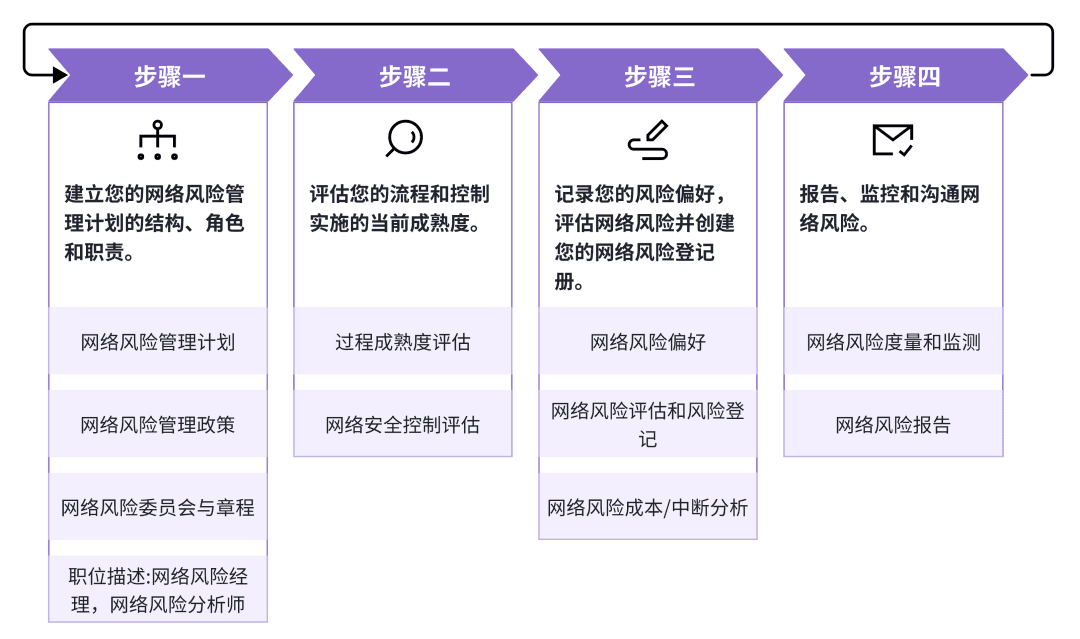
Step 1: Establish Structure and Responsibilities
To build an effective cyber risk management system, it is first necessary to clarify its structure, responsibilities, and governance framework. The enterprise's security and risk management (SRM) leaders need to comprehensively understand the enterprise's business environment and formulate cyber risk management policies suitable for the enterprise's needs. This policy should cover all aspects of cyber risk management, including strategy, operations, and technology. At this stage, enterprises should establish a dedicated Cyber Risk Management Committee to ensure that cyber risk management is aligned with business goals, and establish a clear division of responsibilities. For example, cyber risk managers and analysts are responsible for identifying, assessing, and mitigating risks, while the cyber risk committee is responsible for supervising the entire management process.
Step 2: Assess Current Process Maturity
After establishing an initial management framework, enterprises need to assess the maturity of their current cyber risk management processes. By assessing risk controls and management measures within the processes, enterprises can identify existing security gaps and formulate improvement plans. IT Security and Risk Management Scorecard tools can help enterprise leaders measure the effectiveness of current cybersecurity strategies, compare them with industry peers, and understand their own level of risk exposure.
Step 3: Formulate Risk Appetite and Risk Register
Enterprises need to define their cyber risk appetite, which is the level of risk that the enterprise is willing to accept in its daily operations. This appetite will become the foundation for formulating the enterprise's cybersecurity strategy, ensuring that risk management measures align with the overall corporate strategy. At the same time, enterprises need to establish a risk register to record all identified risks and their corresponding mitigation measures. The risk register not only helps enterprises continuously monitor cyber threats, but also provides senior leaders with a clear risk management roadmap.
Step 4: Report, Monitor, and Communicate Cyber Risks
Finally, enterprises must establish regular risk monitoring and reporting mechanisms. By using dashboards and risk metrics, enterprises can monitor the effectiveness of cybersecurity defenses in real time and adjust response strategies promptly. The core of cyber risk management lies in continuous monitoring and improvement, ensuring that enterprises maintain sufficient agility in a rapidly changing network environment. Cyber risk management in modern enterprises is no longer just about protecting the security of information systems; it also involves decision support at the business level. To this end, enterprises need to quantify cyber risks into measurable financial losses. By using tools such as Open FAIR, ALE (Annual Loss Expectation), and scenario analysis, enterprises can compare cyber risks with other business risks, helping senior leaders make optimal security investment decisions under limited resources. Cyber risk quantification also helps enterprises identify key risk points and formulate targeted mitigation plans for these high-risk areas. For example, enterprises can use outage cost calculators to track the financial costs of risk events that have already occurred and formulate future preventive strategies.

▌Continuous Optimization and Industry Benchmarking
Cyber risk management is a process of continuous optimization. Gartner's research shows that enterprises with mature risk management processes are often more resilient and adaptable than their competitors. By continuously benchmarking against industry standards and competitors, enterprises can quickly adjust their cybersecurity strategies before cyber threats occur. For example, enterprises can use cybersecurity control assessment tools to conduct peer benchmark assessments of their security measure implementations and adjust their strategies based on the results. This continuous risk management assessment not only helps enterprises maintain highly effective cybersecurity defenses, but also ensures that cybersecurity strategies always align with the latest industry trends during business expansion and technology upgrades.
▌SaaSVerify Walks with You
Cyber risk management has become an indispensable part of modern enterprises. By following the steps and principles provided in "The Cyber-Risk Management Cookbook", enterprises can establish a dynamic and efficient cybersecurity strategy, ensuring sufficient capability to cope with constantly changing cyber threats. As a leader in security and risk management, you need to focus not only on defense measures at the technical level, but also tightly integrate cyber risk management with the business goals of the enterprise, ensuring that cybersecurity becomes a key component of corporate competitiveness. In this era of accelerated digitalization, only enterprises with strong cyber risk management capabilities can stand out in fierce market competition. Under the background of digital transformation, SaaSVerify's solutions provide a dynamic and data-driven digital business resilience management system, helping enterprises monitor and evaluate the continuity, security, and effectiveness of business in real time. By integrating intelligent data collection and analysis tools, SaaSVerify can help you effectively identify risks from internal and external sources, ensuring that the enterprise has the capability to respond quickly when security incidents occur. In addition, SaaSVerify is committed to aligning cyber risk management with overall corporate strategic objectives, thereby improving return on investment, helping enterprises reduce potential losses, and optimizing security investments.


