Software Supply Chain Security
CI/CD Supply Chain Risks in LiteLLM Events

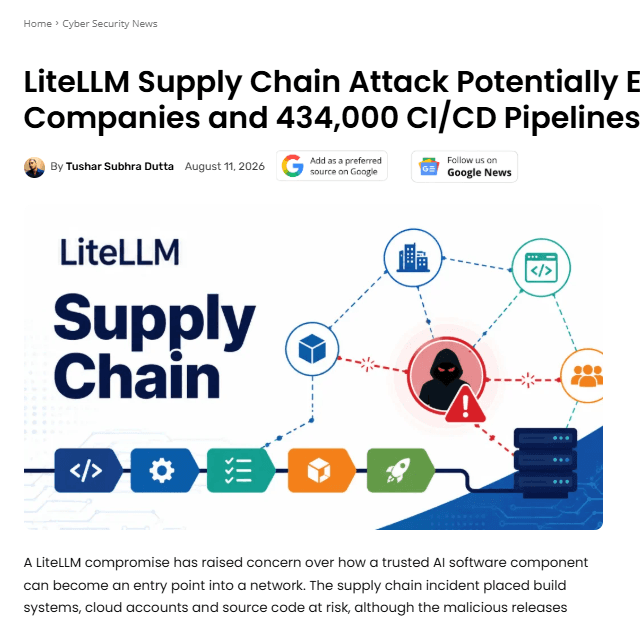
Image|Cyber Security News reporting on the LiteLLM supply chain attack event. Source: Cyber Security News
The Impact of a Short-Window Event
Recently, the LiteLLM supply chain incident has brought software supply chain security back into focus. Public information shows that the affected PyPI versions were 1.82.7 and 1.82.8, released on March 24, 2026, with the malicious package briefly existing for about 40 minutes. The official team subsequently deleted the affected versions and stated that users using the official Docker image, LiteLLM Cloud, or those who did not upgrade to the relevant versions during the window period were unaffected.
If we only look at these response actions, it seems like an event that has already concluded. However, subsequent research has magnified the problem: the potential impact could involve over 2,500 organizations and 434,000 CI/CD pipelines.
This number should not be interpreted as the final list of victims. More accurately, it serves as a reminder: a single dependency poisoning incident can propagate down the automated release pipeline and enter more environments.
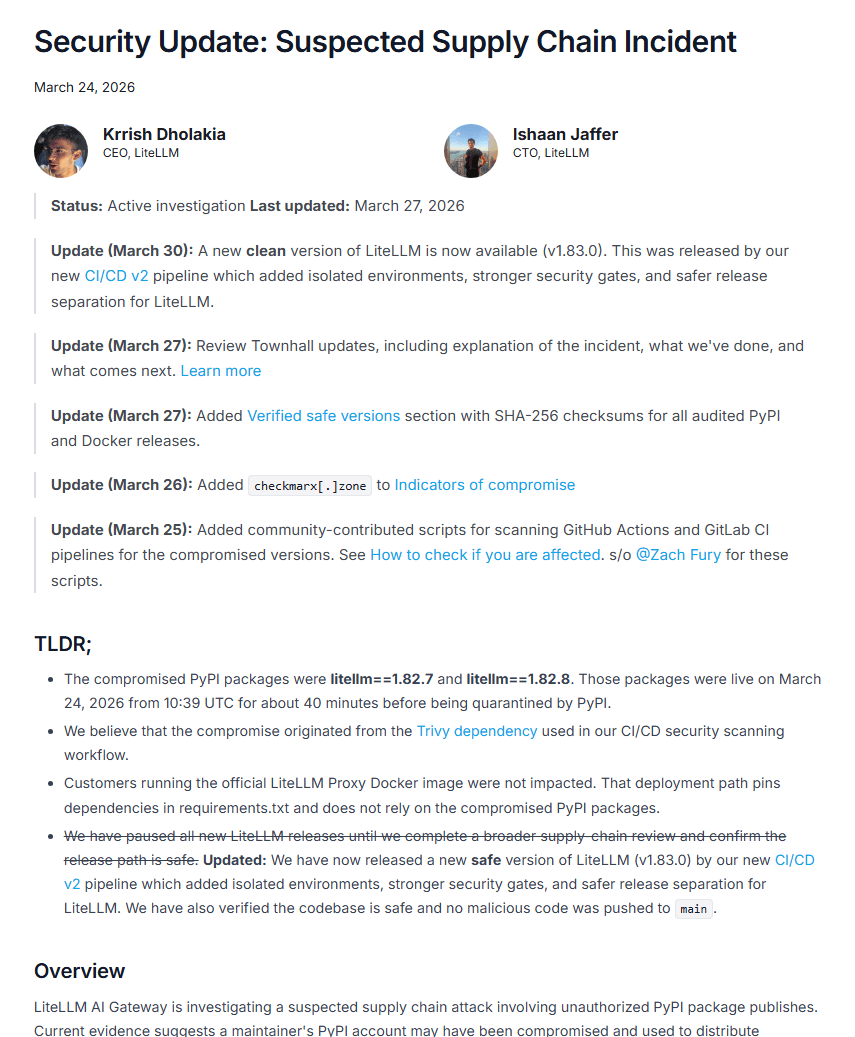
Image|LiteLLM Official Security Update Page Source: LiteLLM
How Dependencies Enter the Automation Pipeline
In the past, many teams were accustomed to treating open-source dependencies as a development-side issue: locking versions, running scans, issuing alerts, and waiting for remediation.
The current problem is that dependency packages may be automatically pulled by CI bots, cached by image builds, or used simultaneously by AI gateways, model services, and internal tools. By the time the security team sees the alert, the package may no longer exist in the current environment, but the runners that executed it, build images, temporary tokens, and cloud credentials still need to be investigated.
The trouble with these types of incidents lies not in how novel the vulnerability itself is, but in the fact that the trust path is too long. Developers trust the package manager, CI/CD trusts the lockfile and cache, production release trusts the build results, and the AI application trusts the gateway to forward model calls.
If any link in this chain treats a malicious dependency as a normal update, no one further down the line will ask: should it have been allowed in?
Investigation Tasks Beyond Version Fixes
The security boundary provided officially by LiteLLM is clear: the affected versions are concentrated in two PyPI releases, and some installation methods are not affected. However, internal investigations within enterprises cannot simply ask whether the current version is secure.
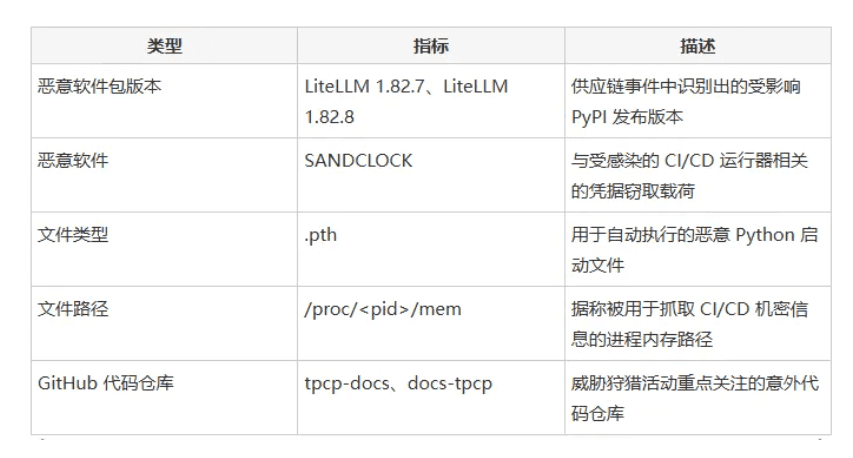
Image|LiteLLM officially disclosed IoC indicators table Source: FreeBuf
In actual investigations, the order of steps can be more straightforward:
First, look at dependency history: Around March 24, was version 1.82.7 / 1.82.8 pulled, installed, cached, or built? Next, look at where it ran: Have the relevant packages been run on developer workstations, CI runners, image build nodes, or AI service gateways? Then, look at the impact on credentials: Are cloud keys, Git tokens, Kubernetes secrets, or model API keys readable in the same environment? Finally, look at subsequent behaviors: Are there anomalies in old images, build logs, abnormal outbound connections, or token usage records?

A true closed loop progresses from "has it been installed" to "what could it access after being installed, and has it been exploited."
From Incident Notification to Internal Review
What these types of incidents truly test is not whether the security team can forward a notification, but whether they can clearly explain the scope of the impact within half a day.
The first reaction is usually to check the version: have any projects installed 1.82.7 or 1.82.8? This step is necessary, but not sufficient. Because many packages do not just exist in code repositories; they may be installed on a developer's local machine, pulled once by a CI runner, or left in old images, cache directories, or temporary build environments.
The next step is to see which automated pipelines it passed through. Who triggered the build, which pipeline pulled the dependency, and can Git tokens, cloud keys, Kubernetes secrets, or model API keys be read within the build environment? The scope of impact in a supply chain incident is often determined not by the package itself, but by the permissions it obtains when it lands.
Further down the line is the review of defensive capabilities. Did the private repository block it? Did the SCA report it? Did the pipeline scan halt it? Did the SOC detect abnormal outbound connections or abnormal credential usage? If these questions can only be traced manually one by one, it means supply chain security is still stuck in the post-incident investigation phase.
Behind this actually lie three types of capabilities: threat intelligence must first consolidate malicious packages, suspicious versions, associated repositories, and IoCs; there must be admission control before artifacts enter the enterprise pipeline; and after defensive actions are completed, validation scenarios must be used to confirm whether they actually worked. Security Centric's threat intelligence, software supply chain anti-poisoning gateway, and security validation platform act more like a continuous workflow here rather than three isolated products.
Writing this is not to pitch products after an incident, but to answer a more specific question: The next time a malicious package appears for only tens of minutes, can your workflow make a determination before it enters the internal network?
Supply Chain Governance Needs to Move Left
The LiteLLM incident should not be viewed merely as AI tool security news. It is more like a toolchain drill: when AI foundational components, open-source dependencies, CI/CD, cloud credentials, and model services are connected, supply chain risks will penetrate organizational boundaries faster than ever before.
A more realistic assessment is that the focus of future supply chain security is not just "are there malicious packages," but "can malicious packages get in, how far can they go once inside, and can we use data to validate the impact when a problem occurs."
If you have also been reviewing AI toolchains and CI/CD credential boundaries recently, you can start with one task: put dependency admission, historical builds, credential rotation, and pipeline validation onto the same checklist.
References: LiteLLM official security updates, CybersecurityNews, SecurityWeek, CloudSEK public research.


