Security Verification and Offensive-Defensive Practice
Case Study | The Practice of Security Effectiveness Validation in a Fortune 500 Automotive Company

Automotive enterprises are facing increasingly severe cybersecurity threats. With the development of emerging technologies such as intelligent driving and connected vehicles, as well as the increasing degree of vehicle intelligence and connectivity, the information systems inside vehicles are becoming more and more complex, providing hackers with more opportunities for attacks. The rapid development of Internet of Vehicles (IoV) technology has led to the continuous exposure of security issues, with increasing risks such as remote control vulnerabilities and data leaks. In addition, automotive companies must also deal with various security threats from enterprise networks, such as cyber attacks and data breaches, which requires great efforts in enterprise-level cybersecurity construction.
▌01 Main Dilemmas and Goals of Cybersecurity Construction for Automotive Enterprises
Deploying more and more security products makes the security system increasingly complex, and the workload of operations personnel becomes more tedious, making it harder to ensure security operations efficiency.
Unable to determine whether security products are functioning correctly, and unable to accurately understand the return on investment (ROI) in security.
Not satisfied with the passive state of "putting out fires", and hoping to detect potential threats before attacks cause damage.
To protect the information assets of automotive enterprises and improve security operations capabilities, security validation has become an indispensable part. Large automotive companies often have high-level security teams. After clarifying the necessity of security validation, what they need to do is to reasonably evaluate security validation solutions and choose one that fits their security development level for implementation, using security validation to achieve a closed loop in security operations.
▌02 How to Evaluate Security Validation Solutions
When evaluating a security validation solution, professional teams will consider the following capabilities:
The quantity, richness, coverage, and update capability of the attack library
The cybersecurity dimensions involved and their coverage
The number of security products that can integrate logs, and the degree of front-end customization
The flexibility of the Agent role
Whether new risks are introduced
The ability to customize attack techniques and scenarios
▌03 From Single Point to Global: Security Validation from Basic to Advanced Playbooks
Security validation runs through the entire lifecycle of enterprise security operations development, helping enterprises improve their security operations capabilities from all aspects and multiple angles.
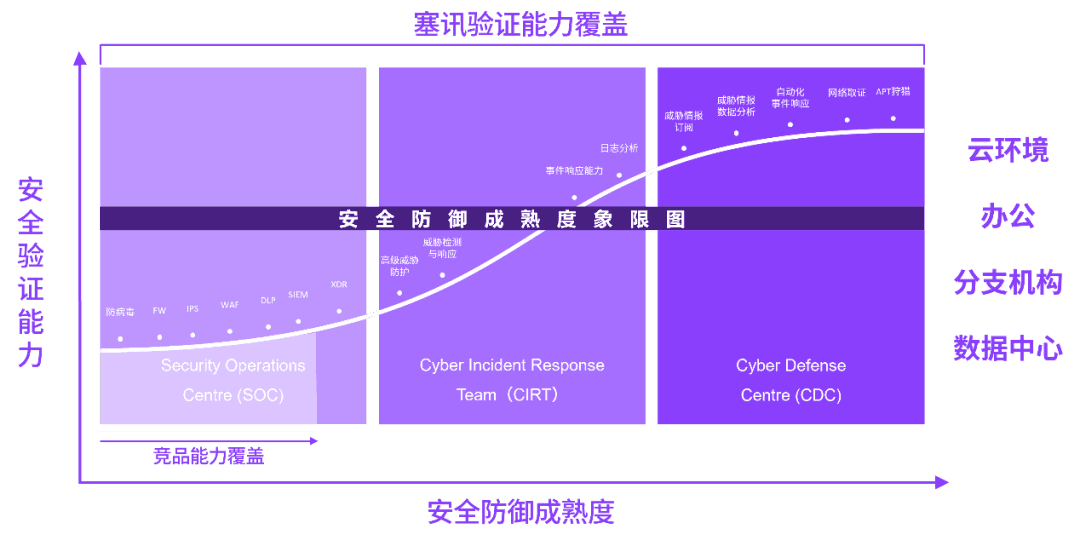
The most basic capability of security validation is to help enterprises validate the capabilities of foundational security products, thereby selecting the appropriate foundational security products and solving common O&M problems. This can be regarded as mastering the basics and maintaining a certain standard. Of course, in the early stages, enterprises can also use the boundary validation provided by Cybersim to first test their ability to respond to external attacks.
The capability of a single security product has its limits. With numerous attack techniques during the hacker's lateral movement stage, a single security product may not be able to identify problems at a single point or dimension. It relies on the correlation analysis of the Security Operations Center (SOC) combined with timely responses from the security operations team to achieve the goal of early detection and proactively cutting off the attack chain.
Enterprises can also improve threat detection and response levels through the Cybersim Security Metrics Validation Platform, validating their incident response capabilities with different attack scenarios, narrowing down alert granularity, and solving the issue of alert fatigue. These enterprises need to solve problems through rich correlation analysis rules. Cybersim can help them create and orchestrate scenarios, improving detection efficiency and accuracy.
Going a step further, security validation can help them test personnel attribution capabilities, the platform's automated response capability and proficiency, etc., helping the Blue Team complete a validation closed loop by restoring the real and complete cyber kill chain and outputting intelligence. In addition, enterprises with strong security defense capabilities and high-level security teams often have more angles to maximize the utilization of security validation.
▌04 Three Closed Loops: Cybersim Helps Enterprises Improve Operations Capabilities
In this case study of a Fortune 500 automotive group, Cybersim started from the Security Operations Center to help the group achieve a closed loop of operations across three dimensions.
A. Optimization closed loop based on SOC correlation analysis rules: This process includes three steps: verification, optimization, and archiving.

By analyzing existing correlation analysis rules and combining them with the custom validation function of validation scenarios in the Cybersim platform, targeted validation is carried out one by one. Subsequently, validation scenarios orchestrated based on real attack events provided by the Cybersim platform can be used to continuously optimize correlation analysis statements, increasing their threat capture capability and probability.
B. Capability improvement closed loop based on the security operations team's emergency response: This process includes three steps: randomized attacks, personnel training, and testing results.
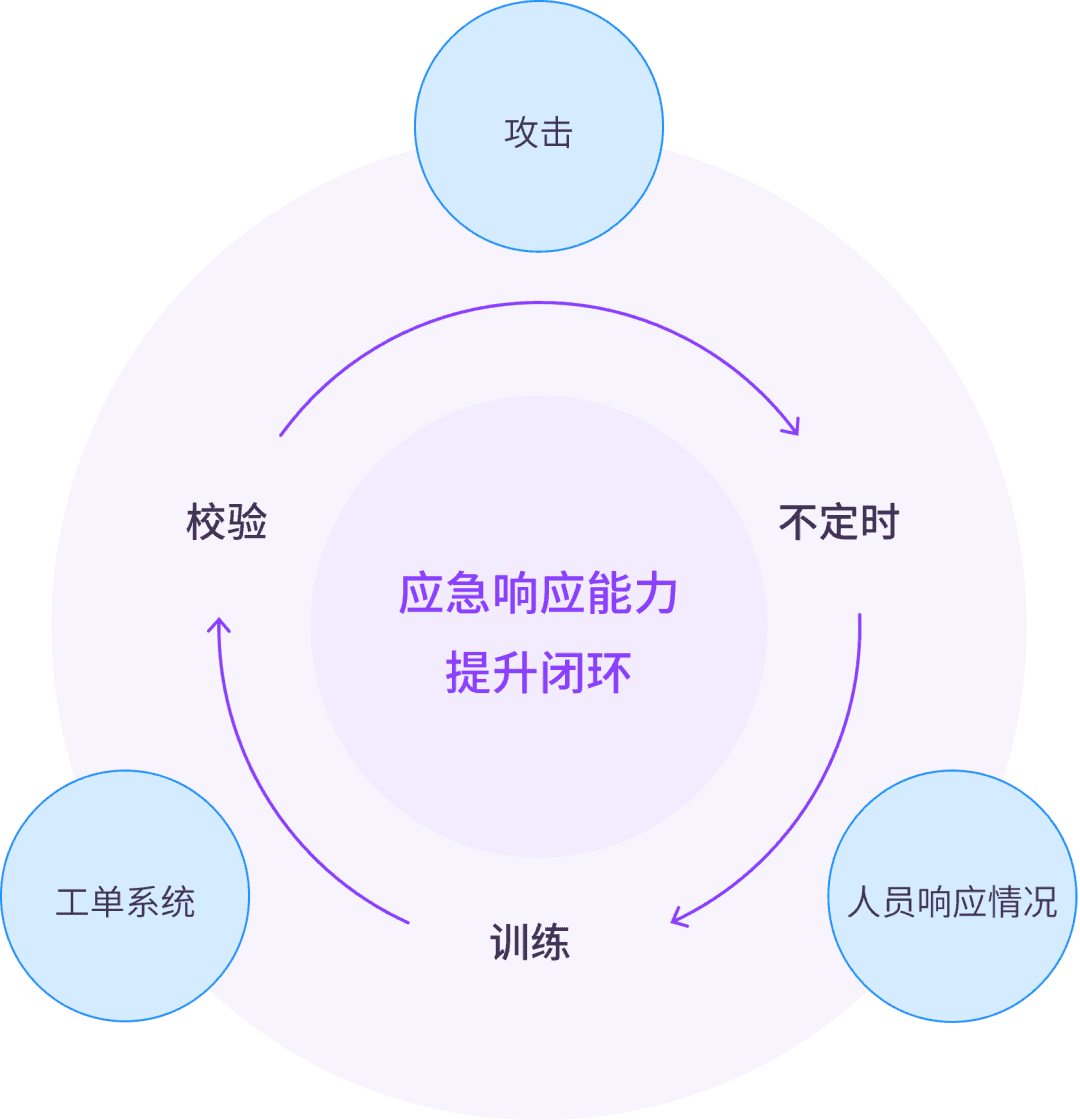
Through the execution of any randomized tasks in the Cybersim platform, the security operations team's handling processes and skill proficiency in responding to various attacks are trained. Moreover, the coordination and work efficiency between departments and colleagues can be strengthened through the ticket system, ensuring that the response process is recordable, measurable, and assessable.
C. Security operations closed loop based on comprehensive capability validation and improvement:
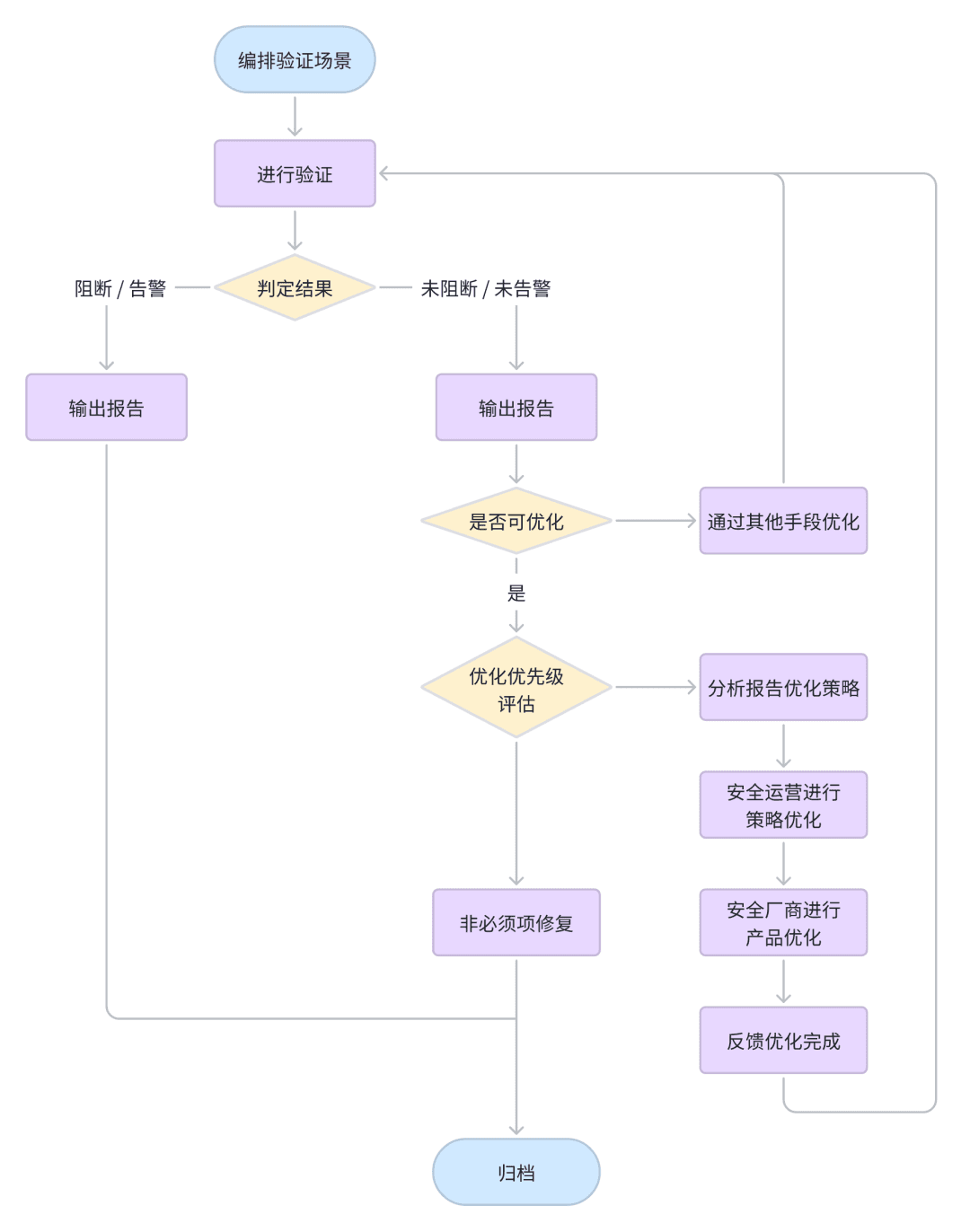
After continuous execution of validation, the Cybersim platform provides realistic and actionable remedial measures and optimization suggestions to help users analyze the results of validation reports, and proposes security policies as well as optimization suggestions and solutions for security vendor products based on the results, truly achieving an effective closed loop from finding problems to solving them.
▌Cybersim Security Metrics Validation Platform Provides You With:
Attack simulation of the complete kill chain
Scenario-based one-click validation or customized validation
Easy deployment and management
Mitigation suggestions based on specific security products/vendors
Individually customized attack scenarios
Scenario classification based on frameworks such as MITRE ATT&CK and Cyber Kill Chain
Rich visual charts
Support for SaaS and on-premise deployment
Continuously updated validation rule library:
Contains 13000+ attack techniques, 1600+ attack scenarios, and 300+ threat groups
Including 1000+ ransomware-related techniques, covering 100+ ransomware groups
Cybersim Security Labs provides the latest and most popular threat intelligence, ensuring you can validate it immediately.
▼
Click the link below to get the full case study
Customer Case Study - Security Effectiveness Validation Practice of a Fortune 500 Automotive Group