Security Verification and Offensive-Defensive Practice
Practical Guide and Deep Reflections on Adversarial Exposure Validation (AEV)

In early 2023, Gartner first proposed the conceptual framework of Continuous Threat Exposure Management (CTEM) and further emphasized the importance of Adversarial Exposure Validation (AEV) in its latest 2024 research report.
The introduction of these two concepts marks a major paradigm shift in enterprise security construction. According to Gartner's forecast, by 2028, adversarial exposure validation capabilities will become the mainstream choice to replace traditional penetration testing.

Before diving deep into these concepts, we need to understand a reality: enterprise security teams are being overwhelmed by various concepts, products, and compliance requirements. At the same time, they not only have to deal with endless alerts and vulnerability remediation daily, but also meet various compliance requirements such as MLPS (Multi-Level Protection Scheme) and cryptography evaluations. In this context, any new concept should not become an additional burden to the team, but rather help them clarify their thoughts and find the core of the problem. So, let's temporarily forget those fancy conceptual wrappings and return to the most basic questions of security construction: What on earth are we building? Then what are we validating? How do we validate? And what actual value can the validation results bring? ▌Vulnerability Scanning: The Dilemmas and Defects of Traditional Security Validation Methods

Traditional security validation is like groping in the dark. We have vulnerability scanning tools, configuration check systems, and regular penetration testing. But these fragmented validation methods are like using a flashlight to illuminate different corners in the dark—every point is illuminated, but we can never see the whole space clearly. Worse still, this piecemeal validation often lulls us into a false sense of security. When a vulnerability scanning report shows a "50% reduction in critical vulnerabilities," have we really become safer? When a penetration testing report shows "no high-risk vulnerabilities found," is our system truly impregnable? Reality tells us the answer is no. This is because attackers never follow the validation frameworks we set to launch attacks. They will look for gaps between separate defensive lines, exploit seemingly harmless configuration combinations to launch attacks, and ultimately gain maximum privileges through a series of low-risk vulnerabilities. This is why even systems that pass all compliance checks can still be breached. ▌Adversarial Thinking: The Inevitable Evolution of Security Validation

This is precisely where Adversarial Exposure Validation (AEV) comes in. It does not aim to replace any existing security measures, but offers an entirely new perspective: from opposition to confrontation. What is the difference between opposition and confrontation? Opposition is static and isolated, like studying whether the placement of your own chess pieces complies with the rules when playing chess. Confrontation is dynamic and holistic, testing whether your layout is truly effective in an actual match. This shift is reflected on multiple levels: At the cognitive level, we no longer view security validation as isolated check items, but as a continuous confrontation. Every validation is a simulated confrontation. In this way, we can realistically assess the effectiveness of the defense system. At the technical level, this means we need to build continuous offensive and defensive capabilities. Instead of simply performing automated scans and detections, we need to understand the attacker's mindset, simulate the attack paths they might take, and validate the effectiveness of defensive measures in real combat. At the organizational level, this requires us to change the way our teams work. Security teams are no longer passive "gatekeepers" but must become active "red-blue opponents" and attack scenario planners, thinking what attackers think and doing what attackers do. Through continuous adversarial validation, we help the team establish new offensive and defensive thinking and improve practical capabilities. ▌Building Practical Adversarial Capabilities: The Complete Implementation Path for AEV

Having understood the essence of AEV, the key question is: how do we translate this concept into specific security practices? This requires us to first break a common misconception: adversarial validation does not mean investing a huge budget to build a dedicated red team. For most enterprises, a more pragmatic approach is to build an incremental adversarial validation system. This system needs to be advanced simultaneously on three levels: technology, process, and people. // Technical Level: AEV Capability Building Solution Based on Enterprise Scale Before carrying out adversarial validation, we first need to understand the evolutionary path of this capability. Gartner's research demonstrates a clear maturity model, which divides AEV into three levels based on enterprise scale and team capability:
▶ For small and medium-sized enterprises, the starting point is to address the most pressing threats:
• First, addressing high-incidence threats such as ransomware
• Second, identifying and monitoring internal anomalous activities
• Third, handling basic server vulnerabilities
▶ For large enterprises, the focus shifts to more systematic defense:
• Comprehensive attack path analysis and lateral movement validation
• Customized attack drills for specific scenarios
▶ For enterprises with the highest maturity, the focus is on establishing continuous adversarial capabilities:
• Supporting purple team collaboration, translating defender discoveries into an attacker's perspective
• Carrying out complete attack scenario simulations
Based on this evolutionary path, enterprises need to choose the appropriate starting point and development direction according to their own circumstances. Specifically, in terms of establishing validation mechanisms, we need: At the perimeter protection level, we need to go beyond traditional port scanning and vulnerability scanning.
For example, for an external-facing Web application:
We must not only validate known vulnerabilities, but also simulate common attack chains. For example: starting from a common file upload vulnerability, validate whether we can bypass upload restrictions to obtain a webshell, and further obtain server privileges.
Validate the actual effectiveness of protection measures such as WAF, IPS, RASP, and HIDS when facing such attack chains. Many times, we will find that seemingly tight protections have various possibilities of being bypassed.
Regularly validate business logic vulnerabilities. These types of vulnerabilities often cannot be detected by automated tools and require in-depth testing combined with business scenarios.
At the lateral movement level, focus needs to be placed on several key scenarios:
Privilege escalation paths: For example, by collecting various configuration files, historical backups, and other information, validate whether there is a possibility of privilege escalation.
Network segmentation effectiveness: Validate whether access control between different security zones is truly effective and whether there is a possibility of bypass.
Credential management: Validate the usage of various service accounts, especially issues such as default passwords and weak passwords.
At the core asset protection level, deeper validation is required:
Data loss prevention: Validate whether there are undetected leak points in the transmission and storage process of sensitive data.
Privilege boundaries: Validate whether privilege isolation between users of different levels is strict and whether there is a possibility of privilege escalation/bypass.
Audit tracking: Validate whether log records of operations on critical assets are complete and whether they can support event tracing.
// Process Level: Integrating AEV Deeply into the Security Operations System Technical validation is only the first step. More importantly, we must integrate adversarial validation into daily security operations. This requires establishing a complete workflow:
Validation Triggering Mechanism:
Combine adversarial validation with change management. Any major system change requires corresponding defensive capability validation testing, rather than just traditional usability testing.
Dynamically adjust validation priorities based on threat intelligence. For example, when a certain type of vulnerability is found to be widely exploited, carry out targeted validation in a timely manner.
Establish a regular validation mechanism, but the content and methods of validation must constantly change to avoid forming a fixed pattern.
Issue Remediation Process:
Establish a tiered response mechanism for issues discovered through validation. Different levels of issues adopt different processing workflows and time limit requirements.
Introduce an evaluation mechanism for temporary mitigation measures. Some issues may not be remediated immediately, requiring evaluation of the effectiveness of temporary protection measures.
Validate remediation effectiveness. The remediation of every issue needs to be confirmed through re-validation.
Continuous Improvement Mechanism:
Regularly analyze validation data to identify common issues and weak points.
Optimize security baselines and control measures based on validation results.
Feed validation results back into security architecture design to form a closed loop.
// People Level: Building a Security Team with Offensive and Defensive Mindset The most challenging part is cultivating human capabilities. To establish true adversarial validation capabilities, the team needs to possess an "offensive and defensive mindset": Capability Cultivation:
Establish an internal offensive and defensive knowledge base to accumulate validation experience and methods;
Improve the team's offensive and defensive capabilities through practical drills;
Encourage the team to participate in external security research and exchange.
Collaboration Mechanism:
Break down internal barriers within the security team, promoting synergy among detection, response, operations, and other teams;
Establish communication mechanisms with business teams to ensure validation activities do not impact business operations;
Develop external partnerships to introduce advanced validation methods and tools.
Balancing Cost and Benefit In promoting adversarial validation, how to balance input and output is a practical question. This requires us to understand an important principle: the building of AEV capability is a gradual process, and enterprises of different scales have different optimal paths.
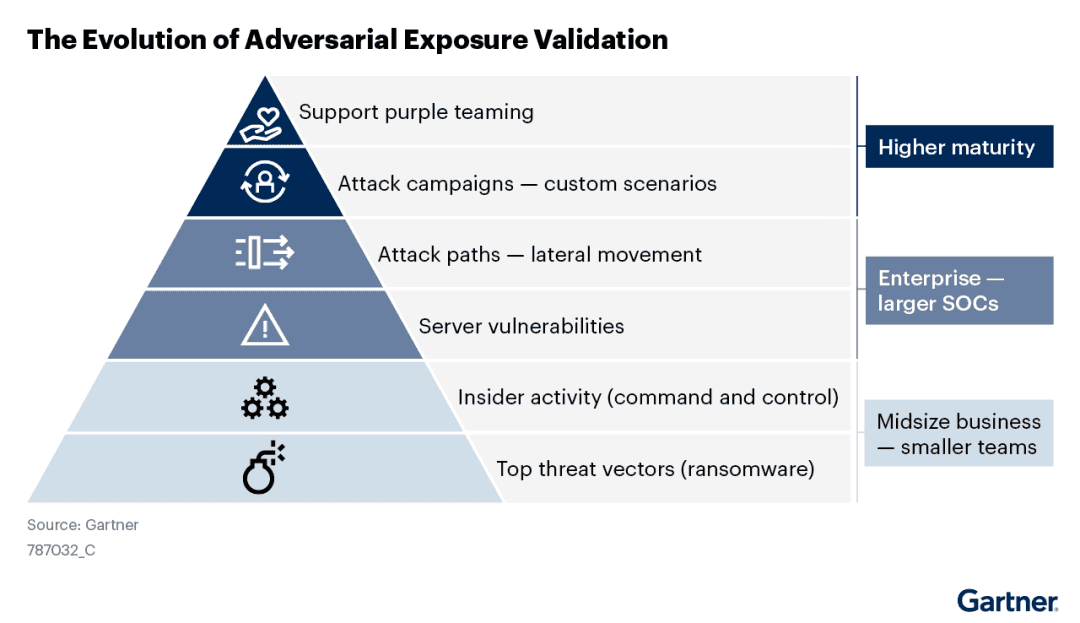
As Gartner's maturity model shows, small and medium-sized enterprises do not need to pursue complete purple teaming capabilities from the start, but should focus on handling the most common threats. Conversely, large enterprises need to pay attention to the validation of attack paths and lateral movement earlier. It is particularly worth noting that in this evolutionary process, "purple teaming" is placed at the top of the pyramid, indicating that the highest form of security capability is deep collaboration between both offensive and defensive sides, rather than simple confrontation. Based on this cognitive foundation, a feasible cost control strategy is:
First focus on high-risk areas to obtain maximum security benefits with limited investment.
Make full use of existing security tools to improve validation effects through integration and optimization.
Automate parts of the basic validation work to concentrate human resources in areas requiring deep analysis.
Establish clear metrics to continuously assess the effectiveness and value of validation activities.
This incremental approach can help enterprises gradually build effective adversarial validation capabilities within existing resource constraints. The key is to adhere to the principles of "continuity" and "practical combat," allowing validation to truly become the driving force for improving security capabilities. ▌The Future: Value and Evolution The true value of adversarial validation lies not in how many vulnerabilities it can discover, but in helping enterprises build true security resilience. In this process, we will find: True security is not a pile of independent defense products, but an organic whole. Adversarial validation helps us examine this whole from an attacker's perspective and discover the weak links within. True defense is not passively waiting for attacks, but actively discovering and patching weaknesses. Through continuous adversarial validation, we can take action one step ahead before attackers find the problems. True capability improvement does not rely on more tools and products, but on continuous practice and accumulation. Adversarial validation provides the team with a platform for continuous learning and progress. In the field of cybersecurity, concepts will constantly change, but the essence of the problem always remains. The value of Adversarial Exposure Validation lies precisely in returning us to the essence of security: discovering problems in continuous confrontation, validating solutions in actual combat, and improving capabilities in evolution. This is perhaps its most profound meaning.


