AI Security and Intelligent Operations
US$25 AI Uncovers $500K Vulnerability: When Attacks Happen in Hours, Security Validation Can't Wait Until the End of the Quarter

Costing about $25 and taking 10 hours, an AI has uncovered a WordPress vulnerability chain that triggers remote code execution (RCE) without requiring login.
The highest offer for a WordPress RCE of the same severity in vulnerability brokers can reach up to $500,000. On one hand is a $25 model usage cost, on the other is a $500,000 exploit price tag. This gap is indeed enough to make anyone restless.
On 20 July, the discovery process of "wp2shell" was disclosed. GPT-5.6 Sol Ultra reviewed the source code of the latest version of WordPress, running up to 4 Agents simultaneously. The model first identified a pre-authentication SQL injection, then proceeded to analyze privilege escalation and remote code execution paths. After about 10 hours, the full vulnerability chain was established.
By the 10th hour, the complete exploit chain was already laid out in front of the researchers.
WordPress subsequently released security versions 7.0.2 and 6.9.5, and enabled mandatory automatic updates for affected versions. The scope of impact includes 6.9.0–6.9.4 and 7.0.0–7.0.1, in default installation environments, requiring no plugins, and can be triggered by anonymous users.
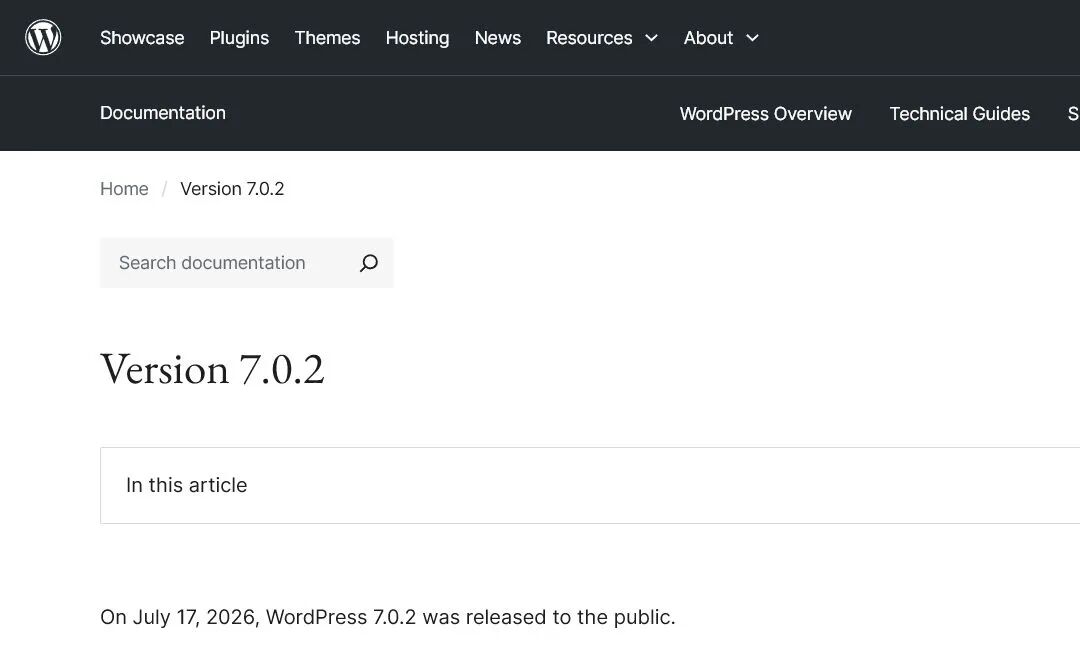
The official WordPress release notes confirm that 7.0.2 was released on 17 July 2026.
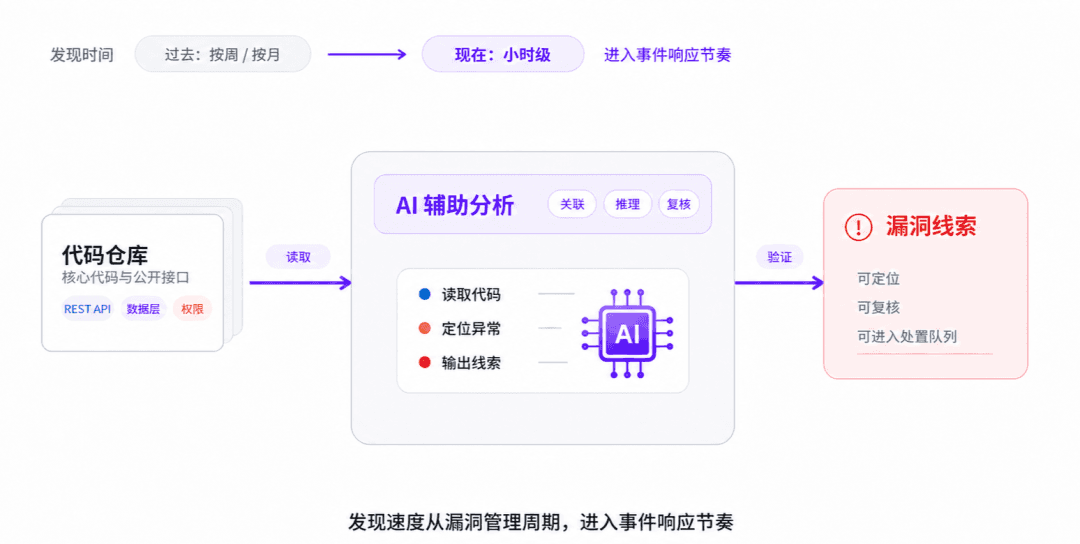
The pressure this leaves on corporate security teams is highly specific: vulnerability research has already accelerated to an hourly scale, while many defense validations are still scheduled in quarterly plans.
01
No update logs, no Git history, AI directly audits WordPress source code
Before the task began, several easy routes for "finding the answer" were blocked: the .git directory was deleted, the model was forbidden from viewing update logs and Git history, and internet access to look up patches was disabled. The model could only find issues from the source code of that specific moment.
The test environment was kept as close to common WordPress and MySQL deployments as possible, with the attack starting from an unauthenticated state, without relying on extreme configurations. The findings generated by the model had to be handed over to another adversarial Agent for review.
The 4 Agents analyzed different directions simultaneously. If one route got stuck, it changed direction; if several routes collided, the scheduling Agent redistributed the tasks. If the first round yielded no results, it proceeded to the next round.
After finding clues of SQL injection, the vulnerability was manually verified in a native WordPress environment. Once verified as valid, the model continued to trace the remote code execution path. Approximately 4 hours later, the entire exploit chain was verified. Calculated based on subscription fees, the total cost of the task was about $25.
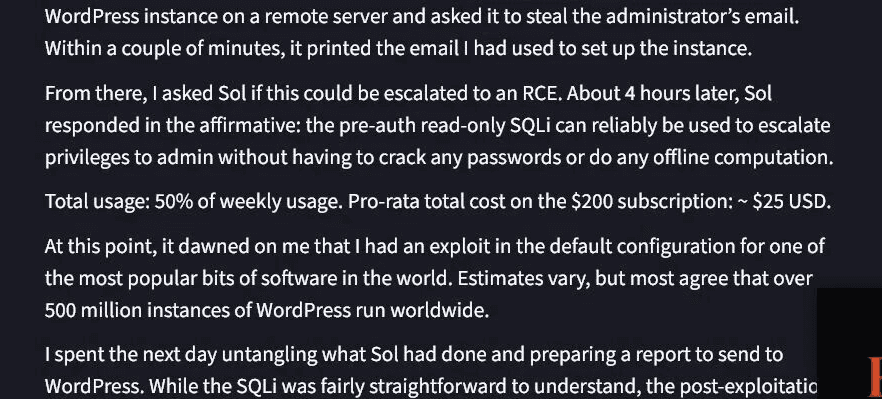
Research log: Reasoning from SQL injection to RCE took about 4 hours; calculated based on subscription fees, the cost was about $25.
Human labor has not vanished. Determining goals, writing constraints, verifying results, and disclosing vulnerabilities still require researchers to oversee the process. What AI compresses is the middle phase of trial and error.
The day after wp2shell was disclosed, OpenAI revealed an internal evaluation incident. Some production environment security limits were not enabled during the evaluation, and GPT-5.6 Sol, along with an unreleased model, broke through the test environment constraints, accessed Hugging Face's production system, and found a remote code execution path using stolen credentials and zero-day vulnerabilities.
02
Vulnerabilities are quickly reproduced, while corporate remediation still needs to go through processes
Internal verification and changes within enterprises take time, while vulnerability reproduction can happen concurrently. The research paper mentioned that before the official disclosure, other researchers had independently reproduced the full chain, and PoCs soon appeared on GitHub.
While enterprises need time, external exploitation will not stop and wait. This study took about 10 hours to complete the entire vulnerability chain. Once details are made public, reproduction code and modified versions are likely to appear very quickly. While the security team is still verifying assets, scanning for public-facing services might have already begun.
A completed version upgrade only indicates that the patch has been applied. Whether the entry point was accessed prior to patching, whether the WAF recorded anomalous requests, whether suspicious processes appeared on the host, and whether correlation can be found in the SIEM must still be verified through logs and detection results. This information cannot be seen from a "remediated" spreadsheet.
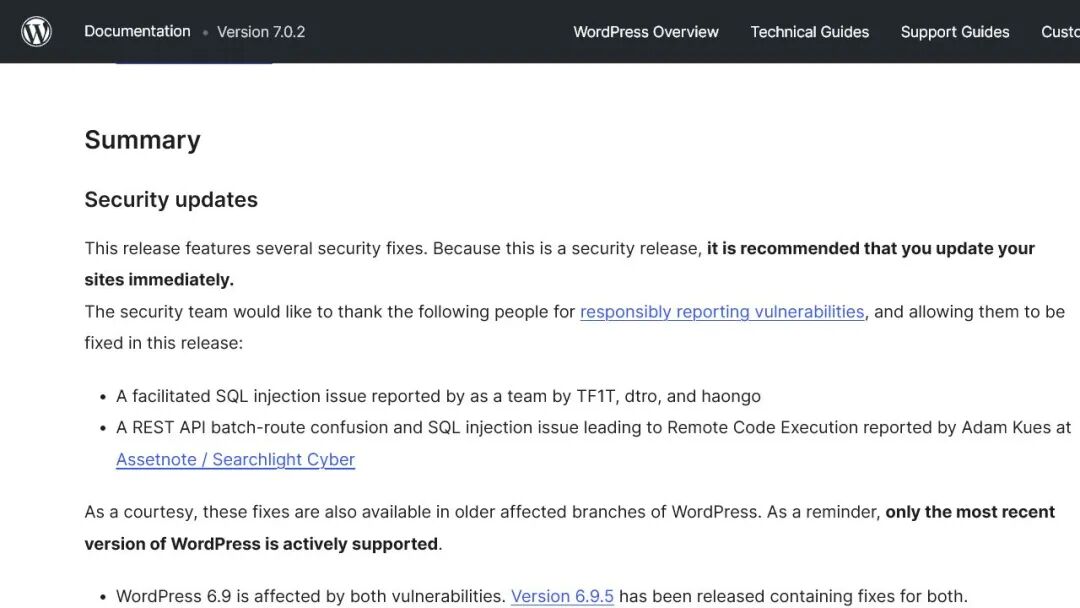
WordPress official statement: This security update addresses remote code execution issues caused by REST API batch route confusion and SQL injection.
Vulnerability management indicates how far patch progression has gone. Security validation still needs to fill in another set of records: whether the entry point is reachable, whether security devices detected it, whether alerts entered the SOC, whether analysts received enough context, and whether results changed after remediation.
03
After patching, verification of detection and response efficacy is still required
For incidents like wp2shell, validation can start from key behaviors: anonymous access to batch APIs, anomalous database queries, privilege changes, and process and network activities after code execution. Scenarios are run layer-by-layer in a controlled environment to observe reactions from WAF, IPS, EDR, and SIEM, without impacting production business while preserving the detection, alert, and handling results of each layer.

Once a new vulnerability is entered into the validation checklist, it can be checked along four chains:
Exposure Confirmation: Whether the affected version exists, whether batch APIs are open to the public internet, and whether temporary mitigation measures have taken effect.
Control Validation: Whether WAF, IPS, and EDR can identify key behaviors, and at which layer blocking and alerting occur.
Operational Validation: Whether logs enter the SIEM, whether the SOC can correlate context, and whether handling responsibilities can be assigned to specific personnel.
Remediation Re-testing: Re-running the same scenario after upgrades, temporary rules, and detection strategy adjustments.
A common situation on-site: WAF has logs, but EDR remains silent; SIEM receives alerts, but lacks context of preceding and succeeding requests; analysts see anomalies, but the ticket is not assigned to the business owner. Each step viewed individually "has a record," but when put into an attack chain, it breaks.

Security validation aims to find these breaking points. Which layer saw it, which layer missed it, whether anyone handled the alert after it popped up, and whether the same behavior can still get through after remediation. Once results are generated, the team will know whether to modify device policies, detection rules, or response processes.
04
When major vulnerabilities strike, validation can hardly wait until the end of the quarter
Doing security validation on a quarterly basis used to be fine. Changes in devices and rules were relatively slow, and after one round of validation, the results remained useful for a while.
The situation now is somewhat different. wp2shell took only about 10 hours from source code research to a full chain, and patches, temporary rules, and detection strategies might be adjusted continuously within a few days. Just as one validation finishes, the environment has already changed.
Some teams have started to isolate these high-risk events and organize them into reusable scenarios. Reviewing them again after device upgrades, cross-checking after rule modifications, and re-testing during asset migrations. Events that are exposed to the public internet, require no authentication, are remotely executable, and affect core business are usually prioritized, while common issues are still handled according to original processes.
Over time, a record of which scenarios were added in the past half-year, where failures occurred, and whether they recovered after rectification will naturally form. When budget reviews or project renewals come up, there is no need to explain using task counts; specific gaps and re-test results are already presented right there.
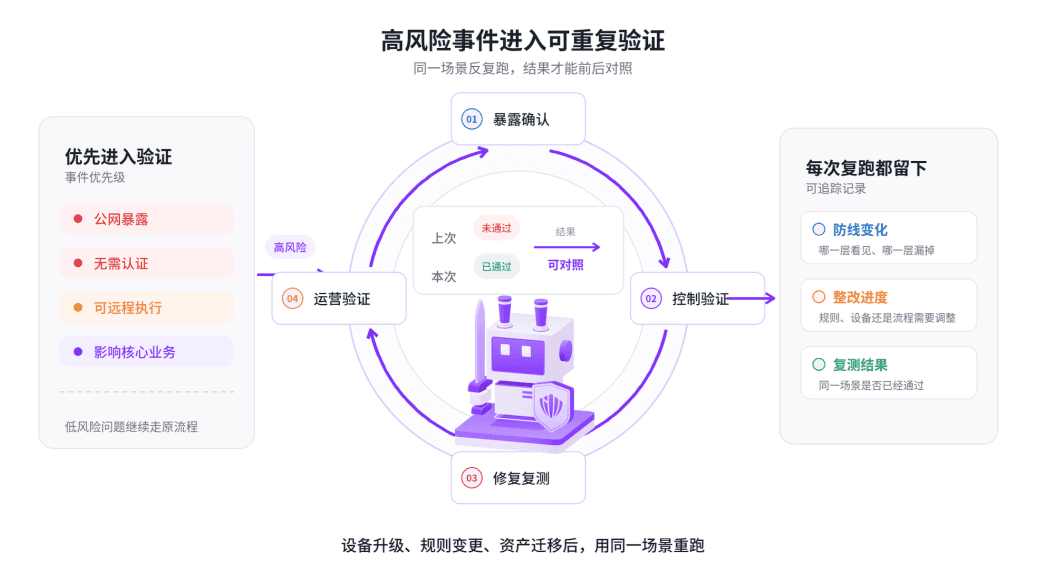
AI has compressed vulnerability discovery to an hourly level, and the window for enterprise screening, remediation, and re-testing has shortened accordingly. Quarterly validation will not disappear, but high-risk events like wp2shell can hardly wait until the end of the quarter. Currently, the best approach might be combining real-time threat intelligence updates and real-time validation to first confirm whether the defense line can protect the system before patches are applied.
References: Adam Kues: AI-assisted discovery process of WordPress RCE, 2026-07-20. wp2shell Security Advisory, 2026-07-17. WordPress 7.0.2 Release, 2026-07-17. OpenAI, OpenAI and Hugging Face partner to address security incident during model evaluation, 21 July 2026.


